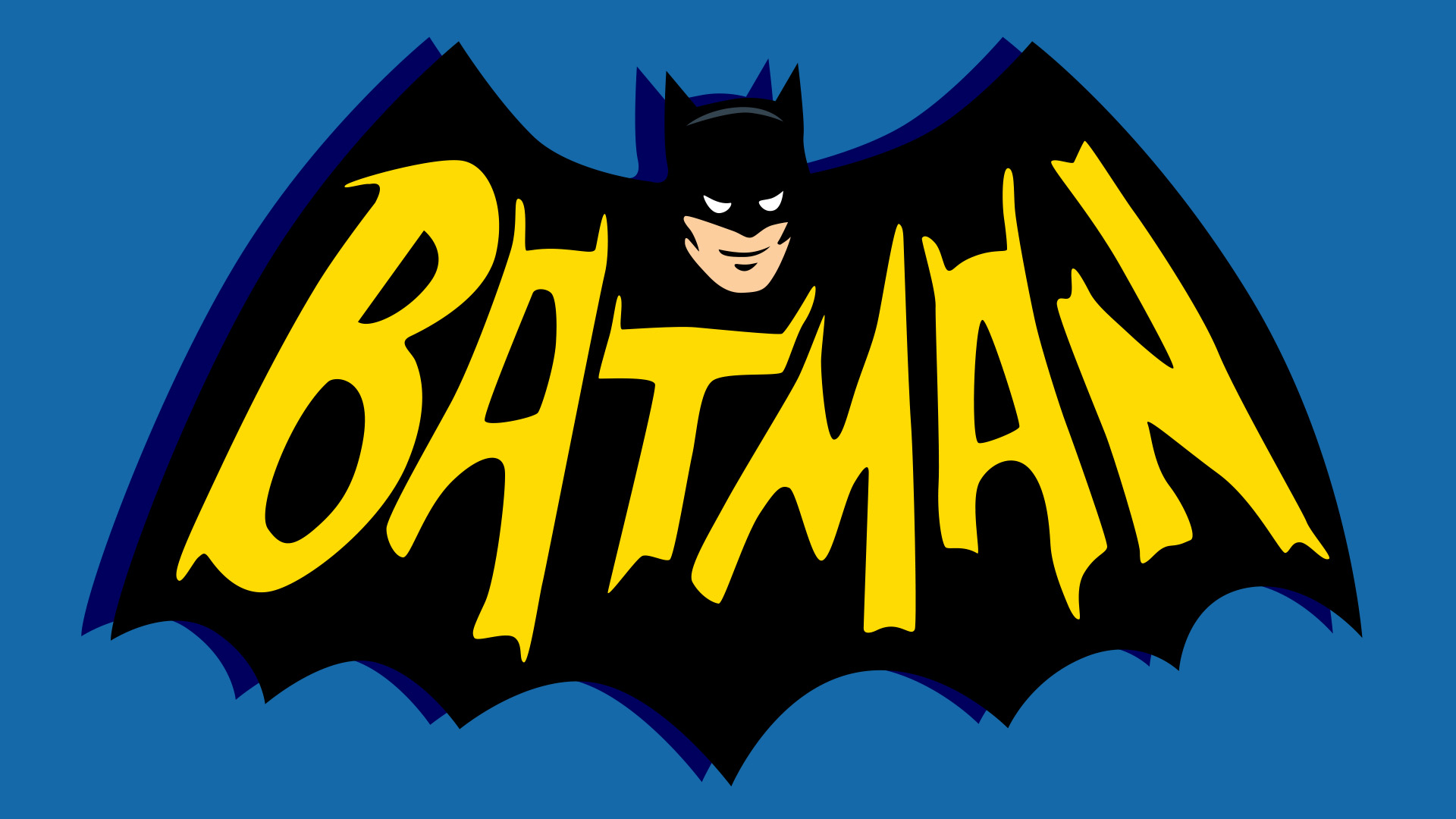
There have been a number of efforts to produce live action films based on the Batman comics. The first, in the 1940s, developed as a series of interconnected episodes released weekly in theaters. There was a respected, high budget feature length film in the 1980s, directed by Tim Burton, which established the production values expected of cinematic interpretations of Batman that remain to this day. But between the serial of the 1940s and the Tim Burton film, there was a cheaply made, one-off theatrical release developed out of a popular television version of Batman. The film, appearing in 1966 and starring Adam West as the renowned “Caped Crusader,” was titled Batman the Movie (to distinguish it from the tv show) and directed by Leslie H. Martinson. Unlike the other attempts to bring the character to live action cinema, Batman the Movie is a comedy, and since its humor derives from a mainly verbal wit, the film’s real auteur is its screenwriter, Lorenzo Semple, Jr.
Composed with a low-budget television sensibility, Batman the Movie won no Oscars and is destined for nobody’s Hall of Fame. The direction meets minimal standards of acceptable filmmaking, as do most of the film’s other technical endeavors. Aesthetically, however, the minimum is not quite good enough. The movie looks shoddy, not much better than the TV sit-coms of the day. As for the acting, the dialogue is enunciated clearly, but “ham” seems to have been included in every character description. And yet, however unsatisfying as cinema Batman the Movie might be, as a vehicle for signs it is a motherlode of cultural significations.
The word ‘Batman’ is presented almost ideogrammatically. The original comic book character has a costume with a yellow oval on the chest, and within the oval is the outline figure of a bat’s head and wings. In the title, the oval is presented, but where the wings should appear, we find the word ‘BATMAN’ presented in letters shaped to conform with the outline of bat wings. Above this word, as in the emblem on the comic book character’s chest, we should expect to find the silhouette of a bat’s head; instead, we find the cartoon head of the comic book character. Alongside this design we find the words ‘the Movie’.
“X: the Movie” is a verbal construction that is somewhat familiar to moviegoers today but was unusual in the 1960s. Indeed, Batman the Movie may be the first film to use such a title. But let’s start with that oval: The word ‘Batman’ we recognize as the name of the character. If he was in the vicinity and we called his name, he would answer. The name as statement signs: ‘Batman is here’. The oval was (according to the fiction) a personal choice of the character, his emblem, his self-presented non-verbal sign of himself. When it is seen on his chest, he no longer needs to be called — he has already answered any possible call — and the emblem presents itself as immediate sign of identification. It says, “Batman is here,” without having to utter it.
In the movie’s opening title, the head appearing above the word ‘Batman’ with letters shaped as wings is a true icon. It is pure duplication of the cartoon Batman and thus represents all that we might expect of his presence, were he here with us. What we have is a graphic presentation of the principle governing much of the presumably humorous significations of the film. Seen through the prism of a perspective especially designed for reading signs, the main title image of the word ‘BATMAN’ presented in Batman’s oval emblem and mounted with the icon of the cartoon character’s head, re-iterates through self-reference the fictionality of the character in a film intentionally reminding us that it is only a fiction.
The principle at work here, serving the rhetorical function of irony, I would like to call “immediate redundancy”: the immediate presentation of a sign appended to another sign, where both signs refer to each other and yet also refer to another object.
Of course, the question is, would the film’s audience translate its title in this fashion? They wouldn’t need to, as their minds would do this rapidly and automatically (although there would need to be some prior training in cultural norms of significance). We are always wearing sign-reading glasses — they’re called “eyes.” What the audience would have been expected to recognize and articulate is the irony in a movie, the title of which asserts the artificiality of its presentation. The fairly hip, culturally informed audience the film was intended for would be expected to recognize the self-referentiality of the title and the artificiality signified and the comic irony implied. They would know that they were not there to indulge the illusion that they were participating in the adventures of the title character; because the title character of the movie is the movie itself, which is wholly consistent with the “Pop-Art” aesthetics that were in vogue in the culture of the time.
___
Smoothness of interaction depends upon the continuous presentation of signs in specific situations, for the appropriateness of the response depends not only on the principal sign but also on the subordinate signs to be observed in that situation. (…) (S)ince remembering (appropriate responses) is unreliable, since it is the consequence of the brain’s capacity to produce random responses if left to itself, learned behavior can be maintained and made reliable only by constant reiteration of instructions for behavior.
To this principle I shall give the name ‘cultural redundancy’.
— Morse Peckham, Explanation and Power†
“Cultural Redundancy” is the theory that stable relations within any cultural group depend largely on the repeated reinforcement of social norms by visual and verbal signs deployable within that cultural group. Peckham discusses this theory in terms of our traffic signs and how we read these in terms of the recurring behavior of other drivers and pedestrians. But it is much easier to see this in a closed cultural example, like the Catholic church (and I mean here the church you may find in your local community). It towers above, covered with medieval iconography, reminding you to be awed by its majesty and history. You walk through the doors – there’s the font, remember to splash yourself with “holy water” — and then into the main hall, filled with people on their knees with bended heads, facing the crucifix hung above the altar. Everything you experience indicates what is expected of you.
All cultural experiences come with similar reinforcement by the signs deployed therein. To be composed of such signs is just the nature of culture itself: their production and deployment; their regularities and irregularities; their continued maintenance; or their transgressions, failures, and displacements.
Batman the Movie is a film about cultural redundancy, and as I’ve noted, its principle comic strategy if that of immediate redundancy, which underscores the film’s thematic interests. The film is about cultural redundancy, because its concern appears to be about why the cultural formations of the United States of the time might manifest a desire for the generation of a fictional character such as Batman.
Batman is something of a cultural parasite. Created by Bob Kane in the late 1930s out of elements borrowed from pulp magazine heroes The Shadow and Doc Savage, he appeared shortly after the appearance of Superman (from the same publisher). Of course he is lacking Superman’s powers, perhaps so as to appeal to those with an inferiority complex: convinced they would never fly, but, gee, wouldn’t it be fun to be a “caped crusader?” In that respect, he actually complements the Superman phenomenon, rather than compete with it for attention. He fits the niche of the “non-super super hero” in the comic universe of the time.
Batman routinely refers to and borrows from popular eccentricities and fads of the day. Science and technology having caught the imagination of the general public by the 1920s, they became the source of innumerable fictional inventions, and Batman has been a part of this trend since his inception: His laboratory produces marvels of science and technology, and he is especially good at creating faster means of transportation and more convenient communications, which were among the aspirations of affluent, post-WWII Americans.
In the 1950s, at a time when EC Comics was the target of Congressional investigations for the portrayals in their magazines of violence and “indecently” dressed female figures, Batman made every effort to avoid physical contact with other human beings (men and women). Violence was reduced to the occasional punch, and Batman could usually fell a foe with a single blow.
Despite its nearly puritanical morality, the comic book was not without a sense of humor. Issues subtly spoofed popular singers, fashion design, and Madison Avenue sales campaigns. In one story, Batman’s archenemy, the Joker, has become a legitimate businessman. Unfortunately, his enterprise fails, and he has to resort to robbing banks to pay off the investors. What was never spoofed, however, were churches, unelected governmental officials, medical doctors, and any married women over the age of thirty (Mom, her apple pie, and all that). In short, any person, position, or institution Americans thought to be unquestionably trustworthy was treated with the utmost respect.
This leaves Batman open to the criticism that he feeds off his culture and repays it by re-enforcing the status quo. Of course, such criticism can be made of many fictional heroes, all of whom are generated from our fondest hopes or our least frightening fears (darker fears tending to breed monsters). But, Batman was certainly among the most ripe for this sort of critique in the 1960s, when such critiques became popular. A critical satire like Batman the Movie was inevitable and appeared in other media, including more than one spoof in Mad Magazine. Not because Batman had changed any or had lost touch with the culture that had given him birth. Rather, the culture itself was changing, effectively losing touch with the cultural norms that Batman had been quite literally sworn to uphold.
There are a number of phenomena occurring in the 1960s that we could discuss as revealing the schizophrenic nature of American culture at the time. Most obvious would be America’s military engagement in Vietnam – the colonial engagement that could not, in principle, secure a colony; the proxy war with communism that could only gain support from unquestioning, self-proclaimed “patriots”; the political embarrassment of both major parties that would lead to one president deciding not to run for re-election; and the election of another president who would be forced into resignation for corruption.
However, perhaps wisely, writer Lorenzo Semple keeps his Batman critique largely apolitical. Exercising our intellects in the presence of such a two-dimensional character as Batman would insult him, and Semple’s asking less of an audience in raising matters of real importance would insult us. Nonetheless, it is rather odd to find a film made in the 1960s, in which the hottest political issue seems to be whether there should be a United Nations or a “United World Organization” as it is represented euphemistically in the film. But since the film largely sets politics aside, so shall we.
___
The movie’s humor hinges on the principle of immediate redundancy: a sign is introduced to refer to an object, but a second sign is presented with it. The second sign points directly to the first sign, but also to the first sign’s object. The second sign is presented so as to assure that the first sign will not be misread by any reasonable interpreter with the necessary contextual knowledge. However, anyone having a reasonably good education should find this reinforcement very obvious (indeed, perhaps a little denigrating of one’s education). Therein lies the humor of it: immediate redundancy is not only over-coding, it is overkill.
Think of a common traffic sign in the United States, the “Stop” sign. Its shape and color form an ideogram of the legal requirement to “stop” by it. But it contains an immediate redundancy: the word “STOP” printed on it. We hardly notice this, because we recognize that the image of the stop sign is intended to be recognizable to those not literate enough to read the word ‘STOP’. But suppose stop signs were posted beneath another sign, reading: “The sign beneath this is a stop sign. You are legally required to stop here.” And on this sign, the picture of a car screeching to a halt. And beneath the stop sign, another sign, “The signs above mean that you are to stop here!” with the image of a policeman handing out a ticket to a car’s driver. Now this is all getting very silly. But this is the nature of immediate redundancy: it multiplies signs without increasing significance, which then raises the question as to the value of the original sign. One benefit of the immediate redundancy of the common stop sign is that it reminds us that traffic laws are social conventions and not divine commands. This knowledge tempts many to ignore stop signs, sometimes at most inopportune moments. But it also reassures us that we humans are in command of the laws we enact and agree to observe.
Batman the Movie is filled with signs pointing at signs pointing at signs. Even Batman’s costume is immediately redundant. The mask is shaped like a bat’s head, the cape shaped like bat wings. Do we really need the silhouette of a bat in the yellow oval on his chest to remind us what the costume signifies?
Although it is frequently in the background of the film, one humorously repeated technique governed by the principle of immediate redundancy surfaces early in a manner we could expect from a film so self-consciously artificial. Our attention is forced to it by a camera shot that has no other purpose. Arriving at the scene of an attempted hijacking of a yacht (which turns out to be an optical illusion), Batman lowers a ladder from the Batcopter, in order to climb down to the endangered yacht. The editing cuts to a shot of the bottom of the ladder, to which we find appended a black sign with white letters reading: “BATLADDER.” Well, of course. What else would it be?
As we might expect, immediate redundancy is used in Batman the Movie verbally as well as visually. At a press conference, Batman tries to explain why he did not stop the yacht from being hijacked; or rather to explain how the yacht was actually an optical illusion; or rather to evade questions concerning the yacht, fearing that answers would cause a public panic. As the press conference ends, a woman claiming to be a reporter from the Soviet Union asks an interesting question. But first, it should be noted that this woman is actually the Catwoman, one of Batman’s fiercest enemies. She’s wearing a disguise, in that she doesn’t have her mask on. We learn later that this indeed is the correct interpretation when, shortly after the press conference, one of her henchmen calls her “Catwoman” in a restaurant while her mask is still off, and she chides him for referring to her “true identity” in public. However, loyal fans of the television show would recognize her as the Catwoman without her mask, because, in keeping with the principle of immediate redundancy, she is wearing apparel made from cheetah furs; that is, from the skin of a cat.
But let’s return to the press conference. The question Catwoman asks of the Batman is simply a request: would he please take off his mask so she could take a photograph of him?
Of course, we know that Batman’s mask is his chief deception. Reviewers and critics find such moments of deception fascinating, psychologically, but we won’t go down that trail. What interests us here is the way Batman successfully explains his refusing the request. To be plain, Catwoman’s request amounts to this: “Would you please reveal your secret identity?” That’s implicit. But Batman makes it explicit. He refuses to reveal his secret identity, because to do so would reveal his secret identity.
Both Batman and the dumbfounded audience are relieved of the embarrassment of this tautological faux pas by Batman’s friend, Police Commissioner Gordon, who argues that such a revelation would ruin Batman’s ability to act as a crime fighter, which on reflection actually makes no sense at all. (Why don’t all police officers wear masks? It isn’t like Batman is operating undercover.) But the damage is done. There isn’t any reason for not revealing his “secret identity,” because in a sense he doesn’t have one. He is always Batman. Bruce Wayne is a convenient fiction. Yet in the context of this blatantly fictional film, this “always Batman” is also a fiction.
As Morse Peckham argues in Explanation and Power, the principle of cultural redundancy is enforced in order to maintain ideological coherence in a conventional system of signs.† Signs are encountered so frequently that their references are assumed true; vouchsafed by familiarity. One sees the psychological advantage in such assumptions. A world of signs held constantly under suspicion, interpretation always delayed by doubt, would prove intolerable. Whatever the significant status of a stop sign, stopping for it is preferable to anxiously wondering if there’s some hidden agenda implicit in its presentation.
But there’s a cost. Immediate redundancy ironically destabilizes the very assurance the redundancy per se seems to offer us. If signs reinforce themselves too frequently, they risk discovery as essentially contentless conventions or as having a referent much less important than the signs seemed to promise. The Batman of Batman the Movie is not a master crime fighter. He is a clown.
To discover the bad faith of a sign is to discover the possibly adversarial and possibly duplicitous agenda of those attempting to signify with it. The cultural redundancy can no longer reassure us and thus loses its power to stabilize cultural responses. We no longer trust those deploying the signs, and we no longer trust the signs themselves. And while one certainly learns to live with such a situation, a condition of total trust can never be re-established.
†Peckham, M.; Explanation and Power: The Control of Human Behavior; 1979, University of Minnesota Press.