Arthur Danto thought that artworks are constituted by their interpretations; that what makes this artwork this one and not that one is that this one means one thing and that one means something else. The art-critical project, on this view, is crucial to the ontological one, for if one’s interpretation of an artwork is wrong, one has wrongly identified it: in fact, one is not actually talking about this artwork at all. “If interpretations are what constitute works,” Danto wrote, “there are no works without them and works are misconstituted when interpretation is wrong.” [1] Of course, this raises the question of what one is talking about, in the case of a misinterpretation. To say that my interpretation of this painting is incorrect is to say that I’ve gotten this painting wrong, which would seem to imply that the question of its identity has already been settled, prior to my interpreting it. Perhaps, in misinterpreting it, I am talking about another painting — wouldn’t it be fascinating, if with each misinterpretation, one brought a new work of art into the world? — but this clearly is not Danto’s view, for he believed that an artwork’s meaning and identity are matters of objective fact: specifically, the correct interpretation of an artwork is the one that “coincides most closely with the artist’s…,” and this subsequently functions as a constraint on the adequacy of subsequent interpretations by audiences and critics. [2]
Danto’s conception of artistic identity is counterintuitive or at least, it is not what one would expect. One would have thought that what makes Ingres’s Odalisque, Odalisque and not, say, Saturn Devouring His Son, is that the first is a picture of a nude woman, reclining on a divan and looking over her shoulder, while the second is a picture of a bulging-eyed monster gnawing on the remains of a bloody corpse, but Danto devoted much of his career to demonstrating that no such “perceptualist” account of artistic identity is possible and even concocted a series of thought-experiments in order to prove it: the (in)famous parade of “indiscernibles” in his The Transfiguration of the Commonplace (1981), which includes a number of perceptually indistinguishable pairs of objects, some of which are alleged to be artworks, some not, but none of which are supposed to be the same work of art.
To take one example: Danto argued that what makes Israelites Crossing the Red Sea a different painting from, say, Red Square (a “clever bit of Moscow landscape”), is not anything that can be visually identified in either painting — they are stipulated as being square-shaped, identical in size, and painted entirely in identical shades of red — but rather, that they mean different things (the first tells an historical story, while the second is a cityscape). What is supposed to make Cervantes’s Don Quixote a different work from Pierre Menard’s Don Quixote, to take another example (which Danto took from Borges), is not the words on the page — they consist of exactly the same words — but their different meanings; the first being one of the earliest instances of the novel and a satire on medieval chivalry, the second an adventurous representative of the literary avant-garde, whose story is “set in the land of Carmen during the century of Lepanto and Lope de Vega.”
Admittedly, these examples are fanciful, but we must remember that in the last century, the artworld served up any number of real instances of artistic indiscernibles: artwork-urinals, which are perceptually indistinguishable from actual pissoirs; artwork-shovels, which one cannot tell apart from the common implements that can be found in any local hardware store; or artwork-Brillo Boxes, which, from the perceptual point of view, cannot be distinguished from their non-art counterparts on the supermarket shelves (at least, not in any meaningful sense). The relevant distinction in these cases is between those things that are artworks and those that are not, rather than between one artwork and another, but the point is essentially the same: what distinguishes an artwork from something that is not art or one artwork from another is not a perceptible quality, but whether it means something or what, specifically, it means. And though we may wonder whether the Readymades and their counterparts in Danto’s fictions tell us anything more than that hard cases make bad principles, the fact that Danto’s thought-experiments were modeled after real art-historical developments means that they cannot simply be dismissed as mere exercises in ingenuity.
Nevertheless, I want to reject Danto’s account of artistic identity. Or at least, I want to reject it, if it is meant as a general account of artistic identity which, of course, it is. The trouble is that there are any number of examples that cut in precisely the opposite direction; cases where it cannot be interpretations that individuate the artworks in question, because they mean the same thing (at least in any relevant sense of the word ‘meaning’) and where perceptible qualities are the obvious differentiae. Significantly, these examples are overwhelmingly of pre-modern origin (by ‘pre-modern’, I mean prior to the eighteenth century and the emergence of what Paul Oskar Kristeller has called “the modern system of the arts”), and the charge that Danto’s theory of artistic identity mishandles art from before the modern era is at the heart of my brief against it. Yet, it cannot be denied that Danto’s cases, which are inspired by postmodernity, are compelling or that the “local” conclusions he draws from them are sound, so one is left questioning whether there can be any general rule of artistic individuation; any universal principle, by virtue of which a particular artwork is the artwork that it is and not some other. Is it possible, perhaps, that the belief that there is such a rule or principle derives from nothing more than the false assumption that when we speak of artworks, what we mean by ‘individual’, ‘different’, and ‘same’ remains uniform, across time and space? Is it because we fail to attend to the fact that, as J.L. Austin observed, “Ordinary words are much subtler in their uses, and mark many more distinctions, than philosophers have realized”? And if we give up the “deeply ingrained worship of tidy-looking dichotomies,” and attend to the different ways in which we speak about art, in different times and places, will we find that the problem of artistic individuation has not so much been solved as dissolved? [3]
I will build my case in a Dantoian fashion, by which I mean that I will base it on a number of real artistic “exhibits,” as well as some fictional variations on them. In each case, the objects in question are clearly distinct individuals and by the reckoning of art historians — i.e. by overwhelming professional consensus — have been deemed different works of art. My purpose is to press Danto’s theory of artistic individuation in a number of ways: Do the artworks in question mean the same or different things? If they mean the same thing, then how can Danto avoid saying that they are the same artwork, a conclusion that is not only contrary to established fact (the art-historical record just mentioned), but which may even be absurd? And if they mean different things, are their differences in meaning substantial enough to credibly account for their distinct identities as artworks? My argument is that the Dantoian cannot successfully answer these questions; that when confronted with such cases, he must deny the very possibility of meaning-indiscernibility, and that he must do so on the basis of an intensely individualistic conception of artistic meaning, one that will often be unsuitable for the interpretation of classical, medieval, and other pre-modern artworks.
My first exhibit consists of two Lamentations, painted by the Northern Renaissance Master, Petrus Christus, which art historians refer to, respectively, as the “Brussels” and “New York” Lamentations. If there is no substantial, relevant sense in which these two paintings mean different things (Erwin Panofsky, who is credited with having created the academic study of iconography, described the New York Lamentation as simply a “plainer variant” on the Brussels version), and if they nonetheless are different works of art, then they represent at least one counterexample to the idea that artworks are individuated by their interpretations. [4]
Petrus Christus, “Brussels” Lamentation (Left); “New York” Lamentation (Right)
In both pictures, the post-deposition scene from the Gospel According to John is depicted, with a common cast of central characters: the dead Jesus; the Virgin Mary; John the Evangelist; Mary Magdalene; Nicodemus; and Joseph of Arimathea. The Brussels Lamentation includes a few additional figures, not present in the New York version, and while they have not been conclusively identified, it has been suggested that they are Mary Cleophas (standing with the Evangelist) and Mary Salome and her husband, Zebede (standing off from the group). Both scenes are set in a natural landscape, although there is a deliberate crowding of the figures, which creates a sense of interior space that focuses one’s attention on the picture’s thematic content, a widely-used technique in Netherlandish painting. The two Lamentations employ nearly identical symbolic elements and tropes, and these provide the primary basis on which my claim of meaning-indiscernibility rests: the instruments of the Passion (hammer, pliers, spikes, and salve jar) are present in both pictures, as are a skull and bones; Joseph and Nicodemus lift Jesus’ body on a white shroud, which recalls the Elevation of the Host during the Mass and reminds the viewer of the relationship between the Host and Christ; and most significantly, the Virgin is depicted as having collapsed into the Evangelist’s arms, in a posture which mirrors that of the dead Jesus. This way of depicting the Virgin, the archetypal example of which appears in Rogier van der Weyden’s Descent from the Cross of (1435-40), has the express purpose of emphasizing her role as Salvatrix Mundi and co-Redeemer, the idea being that Mary’s suffering over her son’s death was so great as to constitute a form of martyrdom, in its own right, and that consequently, her sacrifice should be construed as comparable to Christ’s. (“Oh John, my new son,” Mary says to the Evangelist, in Jacopone da Todi’s Donna del Paradiso (14th century), “your brother is dead: I have felt the blade that was prophesied. Which has killed son and mother, both seized by hard death: they were found embraced, mother and son embraced.”) This conception of the Virgin was part of a larger expansion of her role in the theology of the Latin Church, an evolution whose beginnings lay in the writings of Bernard de Clairveaux and Denis the Carthusian and culminated, in the High Middle Ages, with the emergence of a full-fledged Marian Cult.
Rogier Van Der Weyden, Descent from the Cross (1435-40)
The chief purpose of the two Lamentations, then, is to aid devotion and meditation on the themes of compassio and co-redemptio — on Mary’s suffering over the death of Jesus and the moral and religious significance of her suffering — by way of the distinctive humanist style of Northern Renaissance art. That there are some differences between the two pictures is not disputable, but whether these differences entail differences in meaning, sufficient to differentiate the Lamentations as artworks is hard to credit. It may be true that in comparison with its New York counterpart, the Brussels Lamentation wears its Rogerian influence a bit more on its sleeve, but both pictures reveal Christus’s stylistic and thematic departure from Rogier, as well as from Jan van Eyck — the sense in which Christus sought to split the difference between the two masters’ respective commitments to emotional and pictorial realism — so it is difficult to see how these minor variations would indicate any substantial differences in meaning. There are also slight differences in the contents of the two pictures — in the Brussels Lamentation, for example, Mary Magdalene has turned away from the scene and is on her knees in prayer, while in the New York version, she is rushing to the aid of the swooning Virgin — but art historians have not found these variations significant enough to make a difference to their interpretation either. More substantial differences in interpretation might lie in the additional figures that we find in the Brussels Lamentation. At least one art historian has interpreted the presence of the three Mary’s — Mary Salome, Mary Magdalene, and the Virgin Mary — as representing the “three devotional steps from meditation to repentance to divine contemplation,” and if correct, this difference in meaning between the two pictures (the three Mary’s are absent from the New York version) might be sufficient grounds for the claim that the paintings are individuated by their meanings after all. [5] This defense of the principle of identification-by-interpretation, however, is a weak one. For one thing, we can engage in a little Dantoian fiction and imagine that Christus had produced the Brussels Lamentation, without the three Marys — or alternatively, that he had included them in the New York version — and ask the Danto-supporter what would differentiate them on that occasion. Or we needn’t engage in fiction at all, but merely suspend judgment until we consider another example, where the claim that there are differences in meaning, sufficient to supply the appropriate individuating principle, is even more difficult to sustain: two paintings of the Last Judgment, the first by Van Eyck and the second by Petrus Christus.
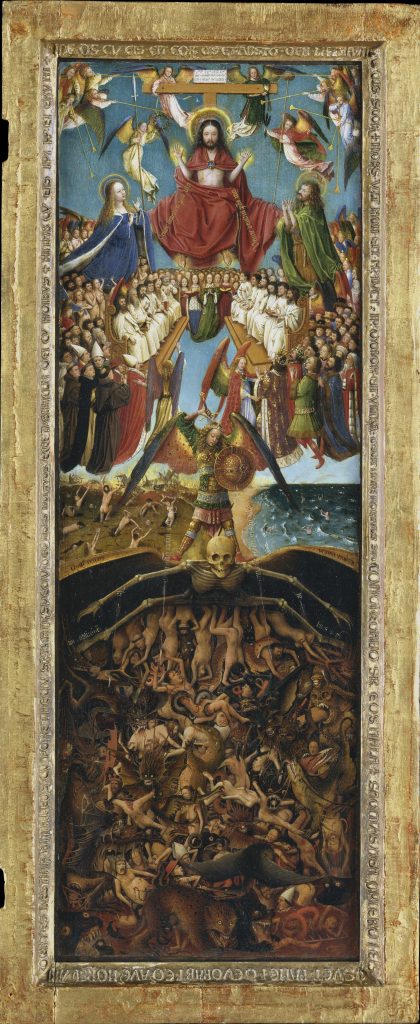
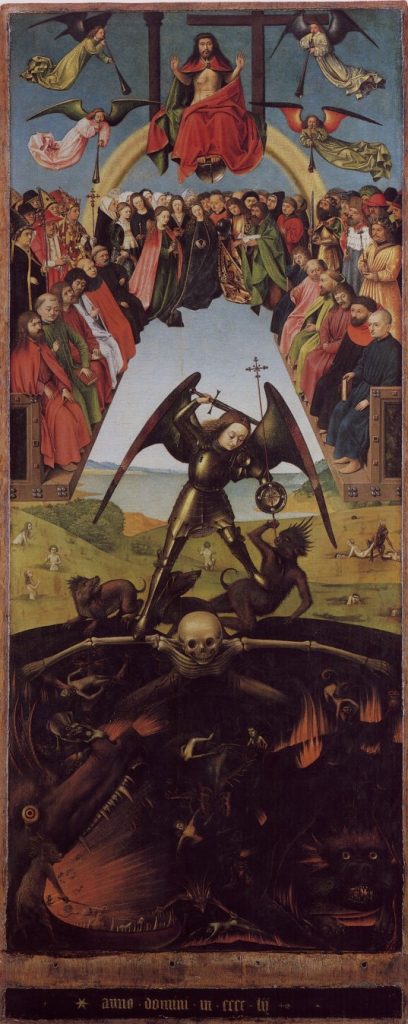
Jan Van Eyck, Last Judgment (1435) (Left); Petrus Christus, Last Judgment (1452) (Right)
These strikingly similar pictures share any number of common symbols and motifs, not to mention a nearly identical formal and narrative structure. We do see some differences in detail — in the Eyckian version, Christ sits in front of the cross, while Christus has him flanked by the Cross and the Pillar of Flagellation; Van Eyck has the damned pulled down into Hell from both the land and from the sea (as described in The Revelation to John), while Christus has them pulled down from the land alone; etc. — but art historians have not treated these variations as having any interpretive significance, and it is hard to see how they could be so construed (the addition of the Pillar, for example, is little more than an exercise in redundancy, inasmuch as it symbolizes the Passion, a function already served by the depiction of the Cross). Panofsky even goes so far as to say that Christus “copied” Van Eyck’s Last Judgment, which, like Rogier’s Descent, became archetypal in the way it presented its subject matter. (It should be emphasized that he does not mean this in a way that implicates the distinctive philosophical issues that arise with respect to artistic reproduction and forgeries). [6]
More conspicuous is the relative sparseness of Christus’s Last Judgment, when compared with Van Eyck’s — the throngs of the Elect and the Damned are greater in number in the Eyckian version; Christus’s St. Michael is more plainly adorned than Van Eyck’s; Christus’s Last Judgment eschews the ‘Chaos Magnum’ and ‘Umbra Mortis’, which appear on the wings of Death, in the Eyckian version; and so on and so forth — but far from suggesting any difference in meaning between the two pictures, the consensus among art historians seems to be that Christus simply wanted to create an image that would be more suitable for a lay audience (Panofsky describes it as a more “readable” version of the Eyckian masterpiece). The pictures say the same thing, but Christus’s says it more simply.
What our examples show is that if artworks are constituted by their meanings, as Danto claims, then where we have two paintings, sculptures, etc., which mean the same thing, we must conclude that only one artwork is present. Obviously, this cannot be construed as meaning that the Lamentations (or Last Judgements) constitute a single individual, as this would be patently absurd: after all, here are two individual things that we can count — one, two — and yet we would be asked to believe that there is only one. What Dantoians have suggested instead is that there is just one Lamentation or one Last Judgment, in the sense that there is just one type of artwork, although there are two instances or tokens of that type. This way of describing the ontological situation has the benefit of avoiding the charge of absurdity — indeed, it is precisely the sort of account that we give for musical compositions, plays, and their performances, woodcuts, etchings, and other repeatable types of artworks — but it raises the question of whether it is an appropriate or even a plausible way of thinking about paintings, sculptures, and other artworks, which, it must be pointed out, have not generally been thought of as being “repeatable.”
While an ontology of tokens and types may make perfect sense for a B-Minor Mass or Hamlet and their performances, it is poorly suited to the ontological treatment of artworks like our Lamentations and Last Judgements. In the case of a B-Minor Mass or Hamlet, there is a very clear sense in which “the artwork” should be identified with the type, rather than with any individual instance of it, but it’s hard to see how this could be true of the kinds of artworks that we have been talking about here. In music and playwriting, the primary act of creation yields an “abstract” object, which is the initial vehicle of meaning and which constrains the content and identity of any of its instances. In the sorts of cases we are discussing here, however, the artist (Christus, Rogier, etc.) has created a particular — an individual thing — not an abstract object, and there is no further abstract object, of which we might plausibly say that it is an instance (just as there is no artist, whom we might designate as that abstract object’s creator). Sameness of meaning in these cases is not the result of their being repeatable instances of a type, but of the prevailing conventions of painting in the Northern Renaissance, including, prominently, the employment of standardized subject-matter and common idioms and tropes, for which there were equally common standards of perception and interpretation.
Another strategy the Dantoian might try is to deny that the pairs of paintings mean the same thing. He could insist that regardless of what the Panofskys of the world say, the stylistic, representational, or material differences already mentioned — the additional figures in the Brussels Lamentation, the relative sparseness of detail in Christus’s Last Judgment, when compared with Van Eyck’s, etc. — do make for differences in meaning and that consequently, the examples bolster the case for the principle of identification-by-interpretation, rather than undermine it. The problem with this move (beyond the fact that it bucks the views of the most authoritative scholars on the subject), is that we can create a Dantoian thought-experiment out of the real-world cases: for example, imagine the Christus Last Judgement without the simplified message or with the simplification reduced to a point at which it no longer provides a plausible basis for differentiating it from its more elaborate Eyckian counterpart. It is hard to see how the Dantoian could object to such a move, insofar as his own theory has been based entirely upon precisely this kind of fictional improvisation. In his Red Squares exhibition, to cite the most prominent example of Dantoian make-believe, Danto simply stipulated perceptual indiscernibility, in order to draw our attention away from the perceptible qualities of artworks and towards their meanings, so why couldn’t we stipulate indiscernibility of meaning in our own exhibits, in order to draw attention away from their meanings and back towards their perceptible qualities?
But, even if one were to grant minute differences in meaning on the basis of these variations, it is not at all clear that every difference in meaning is or could be relevant to artistic identity and individuation. That is, even if we were to agree that there is some hyper-literal sense in which the meanings of the pictures differ, we would not, consequently, have to agree that this provides a suitable basis on which to differentiate them as artworks. After all, Danto’s own real world examples are not literally perceptually indiscernible: the urinal, from which Duchamp’s Fountain was made, was detached from its plumbing, turned upside-down, and had “R. Mutt” scratched into it, and Warhol’s Brillo Box, as Danto points out, was made of wood and stenciled, while real Brillo cartons are made of corrugated cardboard and printed. The point, then, is that strictly speaking neither Fountain nor Brillo Boxes is perceptually indistinguishable from its non-artwork counterpart, and Danto has said that they need not be; that what matters is whether they are indiscernible in some relevant sense. “To be sure, the resemblances were hardly so perfect that discriminability was out of the question,” Danto writes, but “a philosopher would sound foolish who said that being made of wood is what marks the work of art.” [7] Might we not say, then, along the same lines, that it would be “foolish” to suggest that what makes Van Eyck’s Last Judgement a different work of art from Christus’s version are whatever minute additions to its meaning are contributed by the fact that the monster population is denser in the former than in the latter? Why would we think that this detail, trivial as it is, given the interpretive conventions of Netherlandish painting, suffices as an artistic differentiating principle, any more than we would think that such a trivial matter as whether a Brillo box is made of wood or cardboard determines which one is an artwork and which one isn’t?
My suspicion is that what most Dantoians really think is that meaning-indiscernibility in artworks is impossible. Now, this position might seem an obvious loser; i.e. an effort to establish Danto’s theory by stipulating it (if artworks can never mean the same thing, then it is trivially true that one way to count them is to count them by meaning). The challenge to the Dantoian, then, is to provide us with a substantive, non-question-begging reason why we should think that meaning-indiscernibility is impossible in the case of artworks. Fortunately for him, I think that there is such a reason, and it is one that fits naturally in the Dantoian constellation of ideas. Unfortunately for him, it is a reason that is unfaithful to art history.
Danto thought that every artwork “means” by way of a style and that style consists of an artist’s “rhetorical” use of a format. The choice of a specific format reflects the artist’s desire to evoke certain attitudes in his audience, with respect to his subject-matter, which means that form penetrates content in artworks, in a way that renders them more intertwined with one another than is the case in non-artistic pictures, writing, and speech. “The thesis,” Danto wrote, “is that works of art, in categorical contrast with mere representations, use the means of representation in a way that is not exhaustively specified when one has exhaustively specified what is being represented.” Danto illustrated this point by way of a number of real and fictional examples, the most prominent of which involves Roy Lichtenstein’s Portrait of Madame Cézanne, in which Cézanne’s famous portrait of his wife is reproduced, with a diagrammatic grid laid over it, in order to communicate the clinical way in which Cézanne viewed the world. The diagrammatic format of dotted lines, arrows, text-boxes, &c., functions as a metaphor for an overly analytical and somewhat inhuman mind, and consequently, is part of the meaning of the painting, something that is not true of a nearly identical diagram that appears in Cézanne’s Composition, a textbook on the proto-Cubist’s technique, written by the art critic, Erle Loran. Lichtenstein employs the format of a diagram, in order to make a certain point about Cézanne, while Loran employs it, because he is making a diagram. In the latter case, the format is used “transparently” — it is a clear window to the content, which exists independently of it — but in the former case, the format not only is not transparent, it is not a window at all, but rather, a part of the content itself; the key constituent of what is essentially a pictorial metaphor.
This penetration of content by form renders artistic meanings individualized, in a way that ordinary linguistic and pictorial meanings are not. Formats and ordinary linguistic and pictorial contents are repeatable, precisely because they can be separated and made routine: two or more people (or one person on separate occasions) can say the same thing, using different means, or use the same means to say different things. But style and artistic meaning are neither separable nor repeatable, on Danto’s account. The thematic purposes for which an artist chooses a format arise from his personal interests and aims, and these are the unique products of his individual psychology, which is itself, in good part, a product of his context; of his particular time, place, and circumstances. If style is individual and penetrates an artwork’s meaning, then an artwork’s meaning must be individual too, which means that unlike the sentences of natural language, which may differ syntactically, while being identical in meaning and vice versa, artworks can never be identical in meaning or in style: for the Dantoian, then, there are no counterparts, among artworks, to the relations of synonymy and identity of surface structure, which obtain between certain sentences.
Notice that this line of defense rests upon a crucial premise: namely, that an artwork is the fruit born of a unique, individual inspiration. We see this assumption in Danto’s focus on avant-garde, rather than conventional subject-matter — on works like Brillo Box and Fountain, rather than Crucifixions, Lamentations, and such — but it is also reflected in the way that he brings individual style to the forefront, while pushing national and period styles to the background, to the point that they virtually disappear from his account. Given his highly individualistic conception of style — i.e. that it is personalized and renders the content that it penetrates individualized — this focus guarantees that the artworks he talks about, irrespective of the time or place from which they come, will be conceived in individualistic terms, which means that the sort of objections that we’ve voiced here will never arise. This is plainly anachronistic, as it involves projecting notions of artistic individuality and uniqueness, distinctive of modern and contemporary art, onto artworks made prior to the modern era, in which common national and period styles and conventional subjects and standardized iconographies dominated and any and the signs of individuality and genius were manifested overwhelmingly at the level of technique. Though individual style has always existed, in the uninteresting sense that individuals inevitably do things in different ways, the idea of individual style did not become a part of the active consciousness of artists, until the late eighteenth and nineteenth centuries and thus, could not have played a central role in art and art-making, prior to that that time. As Ernst Gombrich observed, “[prior to the late eighteenth century], the style of the period was simply the way in which things were done…In the Age of Reason, people began to become self-conscious about style and styles,” a characterization that also holds for the subject-matter of pre-eighteenth century art, which was similarly conventional: “[T]he majority of…older pictures…represent religious subjects taken from the Bible and the legends of the saints. But even those that are secular in character are mostly confined to a few selected themes. It is curious how rarely artists before the middle of the eighteenth century strayed from these narrow limits of illustration.” [8]
Now, it is true that the idea of the artist as a unique talent goes back to the Renaissance (In his Introduction to Vasari’s Lives of the Artists, George Bull says that “In Vasari the ideas of genius and of the fine arts…assume something like their modern form”), but as just mentioned, it is a notion that speaks overwhelmingly to the artist’s craft, rather than to the content of his work. [9] We value a Madonna and Child by Raphael, over one produced by a lesser Italian Renaissance artist, not because it means anything different from the inferior version — it probably doesn’t mean anything substantially different from hundreds of such pictures — but because of the level of craftsmanship that it represents, in comparison with its lesser counterpart. The idea that the artwork is a unique individual, with a meaning and style all of its own, and the product of unique, inspired feelings and thoughts, however, represents a distinctively Romantic sensibility, evidence of which we begin to see at the end of the eighteenth century, in the writings of the Romantic poets. Wordsworth, in the Preface to the Lyrical Ballads, says that “all good poetry is the spontaneous overflow of powerful feelings…; by a man who being possessed of more than usual organic sensibility had also thought long and deeply,” and Shelley, in the Defense of Poetry, enthuses that “Poetry is the record of the best and happiest moments of the happiest and best minds” and that “the mind in creation is as a fading coal, which some invisible influence…awakens to transitory brightness; this power arises from within, like the color of a flower which fades and changes as it is developed.” [10]
So, whether we are speaking of Renaissance painting, in which artists produced scores of Annunciations, Crucifixions, Depositions, Lamentations, and the like, under the rubric of common national and period styles and employing standardized idioms and tropes, or of ancient Greek sculpture, say of the Kouroi, which were produced in large numbers throughout the archaic era and which adorned graves, but did not represent the individual, deceased occupants, we are talking about works of art, whose individual identities cannot possibly be constituted by their meanings, which are grounded in conventional subjects and standard idioms and tropes and are repeated across scores of individual works. Rather, it is the perceptible differences between the Brussels and New York Lamentations that make them different works of art. It is facts like the Pillar of Flagellation being in one Last Judgment, but not in the other, or Hell being more cluttered with monsters in one than in the other that distinguishes the two paintings from one another, not because these perceptible differences entail or supervene upon differences in meaning — my argument has been that they do not — but because for artworks such as these, the relevant principle of individuation is more like that which operates over ordinary physical objects.
It is impossible to deny, however, that Danto’s examples and the “local” conclusions that he has drawn from them are persuasive. He is right, when he says that what differentiates Brillo Box from regular Brillo boxes is an interpretive property and not a physical one. But what lesson should we take from these conflicting sets of conclusions? That we should redouble our ontological efforts, because there must be a single principle of artistic identity out there, in logical space, which we just haven’t found yet? Or that there is no single principle of artistic identity; that art history may present us with a number of different conceptions of what ‘individual’, ‘same’, and ‘different’ mean, with respect to works of art? I cannot imagine any argument that would decide the question conclusively, if only because so many philosophers’ hopes for a unified-theory-of-everything spring eternal, but a sober assessment of the evidence points strongly towards the second way of thinking about artistic identity, rather than the first. For one thing, ‘art’ is an organic, historical concept itself, by which I mean that what it has meant has evolved over time, so I see no prima facie reason to believe that the diverse things, to which the word has applied, across time and space, share a common principle of individuation.
Notes
[1] Arthur Danto, The Philosophical Disenfranchisement of Art (New York: Columbia University Press, 1986), p. 23.
[2] Ibid., p. 45.
[3] J.L. Austin, Sense and Sensibilia, edited by G.J. Warnock (New York: Oxford University Press, 1962), p. 3.
[4] Erwin Panofsky, Early Netherlandish Painting, Its Origins and Character, Volume One (Cambridge, MA: Harvard University Press, 1958), p. 309.
[5] Joel Upton, Petrus Christus: His Place in Fifteenth-Century Flemish Painting (University Park, PA: The Pennsylvania State University Press, 1990), p. 69.
[6] Panofsky, p. 309.
[7] Arthur Danto, Beyond the Brillo Box: The Visual Arts in Post-Historical Perspective (New York: Farrar, Straus, and Giroux, 1992), p. 36.
[8] Ernst Gombrich, The Story of Art, 16th Edition (London: Phaidon Press, 1995), p. 476.
[9] Giorgio Vasari, Lives of the Artists, Vol. I (1550) , tr. and ed., George Bull (New York: Penguin Books, 1987), p. 19.
[10] William Wordsworth, Preface to Lyrical Ballads (1802), ¶7; Percy Bysshe Shelley, A Defence of Poetry (1821), Albert S. Cook, ed. (Boston, MA: Ginn & Co., 1891), pp. 39 & 40.