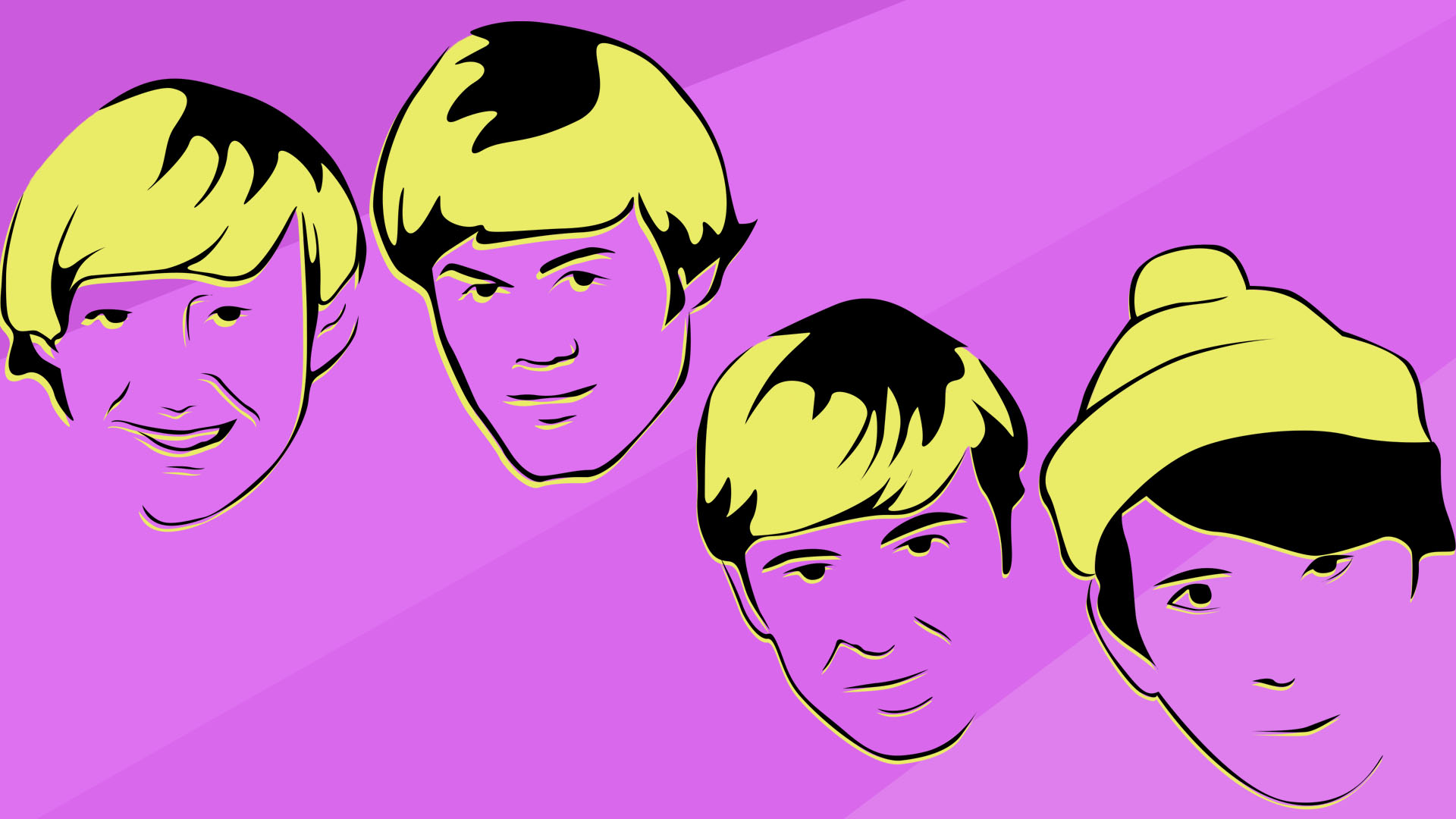
“The tragedy of your time, my young friends, is that you may get exactly what you want.” [1]
___
Monkees, the Signifier
“The Monkees”: this sign signifies a number of phenomena, related yet not identical. For instance:
[1] A television show, broadcast in the mid-1960s; the musical group invented for that show.
[2] A fictional musical group, fronted by four vocalists who appeared in the television show, backed by a loose collective of session musicians known as the “Wrecking Crew.” This coalition produced two albums for record mogul Don Kirshner: The Monkees and More of the Monkees.
[3] An actual professional musical group (from the album, Headquarters onward) composed of the performers on the television show.
[4] The four performers themselves; an identification that would follow them the rest of their lives.
[5] A commercial brand for media and merchandise, from television specials to records, comic books to tee-shirts, plastic lunchboxes to toy “Monkeemobile” cars.
Monkees, the TV Show
In 1966, Bob Rafelson and Bert Schneider put together a situation comedy about a struggling pop-rock band, The Monkees. Television and music historians usually credit the inspiration to the Beatles’ A Hard Day’s Night, but that film’s director, Richard Lester, had carefully balanced a fictional plot about a randy old conman related to Paul McCartney with reflections on the very real working-class Liverpool origins of the band. The TV series Rafelson and Schneider developed owes much more to the Beatles’ second film, Help!, a parody of the James Bond films with mild but obvious satirical jabs at British bureaucracy, colonialism, religious cults, and the comfortable lifestyle the members of the band seemed to settle into after achieving commercial success. Rafelson and Schneider thus invented a band supposedly struggling for success, but they clearly are not struggling very hard. Despite spending every show trying to find gainful employment, they appear to eat well, dress well, spend plenty of time at leisure, and always come up with the rent for their apartment. They clearly have money coming from somewhere. And the performers chosen to play this band actually had experienced some success in life already: Micky Dolenz had played in a minor hit of a TV show; Davy Jones had appeared in a popular Broadway musical; and Mike Nesmith was the son of the woman who became wealthy as developer of Liquid Paper. Only Peter Tork came from a modest, middle-class home of respected academics. Eventually, they would find themselves singing songs protesting middle-class conformity or the Vietnam War, but they never could sing. Of the four, only Nesmith and Tork had credentials as musicians – Dolenz and Jones were hired as actors – and this played a crucial role in the development of the group dynamics thereafter.
With the Rafelson/Schneider-invented rock band lacking any roots in a recognizable social class, the plots of the episodes were a free-form effort to throw ideas at the screen and see what worked. Usually, the narrative referred not to situations anyone would actually experience in life but to other TV shows and old films, poking fun at genre conventions and audience expectations, rather than developing comic personality or well-rehearsed schtick, which characterized successful comedy teams from Laurel and Hardy to Monty Python. Even the slapstick – of which there was plenty – was singularly unconvincing. The Monkees did not perform as a comedy team, they performed as young people pretending to be a comedy team. To cover for any deficiencies, the production crew deployed techniques more common to animated films: flat cinematography; rapidly paced jump-cuts; two-dimensional characterizations; absurdly exaggerated gestures and bits of business; and the occasional pop song. The show became a kind of “live-action cartoon.” That kind of comedy could only find an audience among those wholly unfamiliar with what professional comedy might look or sound like, which meant early adolescents aged 11- 14; i.e. those experiencing hormonal changes but uncertain how to respond to them. This was historically and commercially important, as it represented the same youthful audience that had greeted the Beatles in their first appearances in the US in 1964. But by 1966, the older members of that audience had settled into their sexual maturity. They were no longer dreaming of a perfect romance with an imagined mop-top singing “Love Me Do.” They were having disappointing relationships and mooning over “Norwegian Wood.” But their younger siblings were now passing through that early pubescent phase and needed their own group of mop-tops singing “I Wanna Be Free.” (What teen-ager doesn’t?) Enter the Monkees.
Monkees, the Band
In casting the show, Rafelson and Schneider made an interesting misstep, one that effectively would determine all that was to follow. As the musicians in the cast, Nesmith and Tork not only aspired to become professional songwriters and performers, viewing the TV show as simply a means of gaining exposure, but they had formed friendships with members of the developing Los Angeles music scene. The musicians on the Don Kirshner albums included some of those friends. When Nesmith saw the credits on the first album, which listed none of these actual musicians but instead assigned instruments to the members of the fictional TV “band,” he went ballistic and not only demanded proper recognition for the real musicians, but initiated an idea for taking the whole matter to another level. The fictional band would become a real band: Nesmith, Dolenz, Jones and Tork would play their own instruments on record. Instead of the brief public appearances where they sang before a backing band, in promotion of the TV series, they would set out to play concerts themselves.
At first, their contracts with the production companies prohibited this, but Kirshner, confident in his position, made the simple mistake of releasing a 45 RPM single that had not been approved, thereby breaking his own contract. He was let go, and with music for the show needing to be made, the producers gave Nesmith the green light to form a real band out of his TV show colleagues. Not as easy as it sounds: Dolenz was a surprisingly good singer, but couldn’t play drums; Jones was a pretty good drummer, but as lead singer his voice had limited range. Nonetheless, the performers decided to adapt to the band’s television image and rehearsed accordingly.
The band probably saw themselves at a crossroads but landed in a pop-culture dilemma instead. By the time they began working as a band of musicians, everyone knew that they had not been the primary musicians on the first two albums released under the Monkees brand. Further, pop-culture itself was changing rapidly, in ways only hinted at in the early ’60s. Older viewers of the first season of the TV show had grown up, and by 1967 – the Summer of Love; Haight-Ashbury; Sgt. Pepper; Monterey Pop; etc. – they now found the show tawdry, superficial, banal, and childish. To the post-mod, post-British Invasion audiences of 1966, The Monkees TV series looked witty and possibly even nostalgic; a throwback to the innocence of ‘64. To the hippie drop-outs of the new Counterculture, both the TV series and the band looked plastic; a corporate puppet-show; a cynical comment on the manipulation of America’s youth.
Members of the band were increasingly aware of this and annoyed by it. Having decided to enter the community of professional musicians, they yearned for whatever respect their real talents could earn, when judged on their own merits. Instead, the jury had already found them guilty of being created for a television show and a not-very-good one at that. They were judged as pretending to be countercultural, while acting as shills for the status-quo. In truth, it wasn’t quite that bad, and the prejudice against them was never quite that vicious. But the fact remains that musical innovations appearing on Headquarters, Pisces, Aquarius, Capricorn & Jones, and The Birds, The Bees, and The Monkees all began disappearing into bargain-bin oblivion, while Sgt. Pepper’s Lonely Hearts Club Band swept over pop-music like a tidal wave.
The Frodis Caper
The band attempted to use the TV series to reconstruct their image. Having acquired complete creative control, they tried to re-direct the show to subvert the medium itself. Most notorious was an episode co-written and directed by Dolenz, “The Frodis Caper.” An evil wizard kidnaps an hypnotic alien, intending to broadcast its appearance over television and take over the world. The boys in the band must send the alien home while releasing its hypnotic power freely into the atmosphere, thus bringing peace and calm to all. The episode ends with the performance of the anti-war song “Zor and Zam.” (‘Frodis’ was a codeword with Dolenz’s friends for marijuana, and veiled allusions to the drug abound.)
“The Frodis Caper” is not very well made, and the performances throughout are annoyingly hammy, but it does move along well, and the very idea of it makes for interesting television. Alas, the band didn’t really understand the corporate politics of the medium. Their second season ran because they were contracted for it, and the first season was already booked for syndication. But the production companies could see the writing on the wall. The Monkees were becoming unmanageable. Ratings were slipping fast. The show’s core audience still consisted of early adolescents, and the Monkees were now playing well beyond their cultural understanding. As for the young-adult hipsters the Monkees hoped to attract, they had switched off long before. The series was canceled.
Head, the Movie
There are interesting stories surrounding the making of Head: The Monkees, Bob Rafelson and Jack Nicholson spending a weekend smoking copious amounts of marijuana while spewing ideas into a tape-recorder; communications theorist John Brockman becoming the “head” appearing on the promotional advertisements, for no good reason; and there is also much to be said about the film itself. Its evident influences from experimental film-maker Kenneth Anger; its relationship with a now forgotten Roger Corman film The Trip and with Dennis Hopper’s Easy Rider; its attempt at non-linear circularity (ending where it begins, but with nothing actually leading there); its obvious yet disturbing symbolism (they never escape the box). I will merely quote a brief review of the film (revised for corrections) that I wrote for the Internet Movie Database [2]:
Accidental masterpiece: Almost laugh as the Monkees reduce their entire career to a one-minute TV commercial about dandruff. See the 50-foot Victor Mature try to figure out what he’s doing in this film. Hear Frank Zappa (with his pet cow on leash) tell Davy Jones “Your music is awfully white.” Experience the Monkees’ live performance as a real rock band playing the proto-punk “Circle Sky.” Listen as Davy Jones sings a Harry Nielsen song about having a transsexual father. Be as confused as Teri Garr is when Micky Dolenz makes sexual innuendos about her in her film debut. Witness futile protests against the Vietnam War leap out of nowhere and just as quickly disappear. Watch Mike Nesmith spit on Christmas while wearing a velvet Victorian smoking jacket in a cobwebbed Gothic horror-movie soundstage. Let yourself drift into karmic bliss with Peter Tork, inspired by a comic-book version of Indian mysticism delivered by a hammy character-actor. Discover Academy Award winning director Bob Rafelson’s first feature length film, attacking the television phenomenon he himself had invented, as written by Academy Award winning actor Jack Nicholson. Pretend it’s not happening, when the Monkees commit group suicide by jumping off a bridge. And take as many drugs as the cast and crew evidently did while making this film.
With Head, the Monkees revealed themselves as the angriest, snottiest entertainers in Hollywood history. It is bewildering to discover that they blamed the failure of this film on bad promotion. To be sure, it was virtually non-existent, but did they not recognize how angry, how depressing, how self-destructive this film actually is? Head is a bad trip on acid into the suicide ward of a mental hospital. This film reveals why life in the later 20th Century was almost unbearable … if you were lucky. It’s not simply that Western culture was suffering from serious information-overload, but the information itself was bad. In fact, it was the overload effect itself that kept people going, since this allowed people to keep distracting themselves with one crisis or another. If news from Vietnam became too much to bear, you could turn the channel and watch a documentary on the rising unemployment rate instead.
The “positive” response to the reality revealed in Head was Woodstock: three days of mud and bugs and bad food and bad acid. All taking place behind a steel fence, under the lovingly watchful eyes of a veritable army of New York State Troopers, which meant that the “freedom” of Woodstock Nation was as illusory as the song John Sebastian thought he was singing while so strung out he could barely speak.
The one good thing occurring there was Jimi Hendrix’s stunning improvisation on “the Star Spangled Banner.” A year or so previously, the Jimi Hendrix Experience had gone on their first national tour of America, as the band opening for the Monkees. See? It’s all connected somehow.
Head, the Soundtrack
With the digitization of music in the current era and the collapse of physically recorded music, the very notion of a “concept album” has become outdated. It’s difficult to relate how important the phenomenon was to the music of the 1960s and the Counterculture that enjoyed it. The basic model of the concept album goes back to the song cycle of the early 19th century. It was originally codified in the 1950s by Frank Sinatra, as a sequence of songs developing a mood or idea. The first album in the rock idiom to be widely recognized as a concept album was the Beach Boys’ Pet Sounds, a sequence of songs about a doomed summertime love affair, ending with the recording of a dog barking at a train disappearing down the tracks. But the concept album has an interesting problem: Since the songs can be played individually, what really holds the album together beyond its physical formatting? By the end of the ’60s various composers responded with the development of the so-called “rock opera,” the most cohesive of which was probably Weber and Rice’s Jesus Christ Superstar, since it had a linear narrative. Yet there were a number of artists that scorned linearity, and still tried to elevate their album to the point where the experience of the whole would be greater than the sum of its parts.
Head includes the strongest music the Monkees committed to record. It’s certainly the best sounding. Of the six traditionally structured songs on the album, three are basically in the sub-genre of what we now call “garage rock”: fast guitar-driven shouts at the dance floor, reminiscent of, say, the Electric Prunes’ “I had too much to dream last night.” But even these songs sound remarkably fleshed out with layered instrumentation and subtly pumped reverb. The psychedelic thunder of the organ-driven “Porpoise Song” is lush in arrangement and recording, and in their own ways so too the moody folk ballad “As We Go Along” and the mock show-tune “Daddy’s Song.” After more than fifty years, the album still sounds good. Even Sgt. Pepper sounds dated by comparison.
But the non-traditional material is what really holds the album together. Primarily, there are all the sound-effects and bits of dialogue from the movie. They have rhythms of their own and link the traditional songs by leading into them or away from them.They comment on the songs and are commented on by the songs; e.g.: the pseudo- Eastern “Can You Dig It?” rattles to its conclusion whereupon Davy Jones is heard to remark, “I’d like a cup of cold gravy with a hair in it.” The pretensions of the song are thus undercut by a crude joke about consumption. The album concludes with an untitled orchestral string composition by Ken Thorne, snapped into the last real track of the album, “Swami – Plus Strings, Etc.,” a miniature aural collage. It opens with a pedantic but vapid recitation of some vaguely Hinduistic aphorisms, over repeated dialogue and effects from the film, bleeding into a reprise of “Porpoise Song.” Then we hear the truck that in the film carries the band (trapped in a fishbowl) into the studio and then, suddenly, the cheerful arpeggio of violins with orchestral backing, a much needed tonic to all that has come before. The key is the non-traditional acapella, “Ditty Diego – War Chant,” a self-lacerating parody of the theme song to The Monkees TV show:
The money’s in, we’re made of tin, we’re here to give you more
The money’s in, we’re made of tin we’re here to give you
(- gunshot -)
Davy: Give us a ‘w’
Peter: Give us an ‘a’
Micky: Give us an ‘r’
Mike: What does it spell?
(- explosion -)
The Monkees thereby contextualize themselves as trivial distraction to horrors of the real world then unfolding in Vietnam – a commodity for sale, having no integrity or higher aspirations. And knowing this is exactly the cause of their despair:
A face, a voice
An overdub has no choice
An image cannot rejoice
(…)
Wanting to feel
To know what is real
Living is a, is a lie [3]
The non-linear circularity that I noted of the film’s structure is an artistic mannerism. But in the album, this becomes a deadly trap. Some of the songs complain of it explicitly, especially “Long Title: Do I Have To Do This All Over Again.” But it lingers suggestively throughout, even in the melancholic “As We Go Along,” where there is a developing sense of having nowhere special to go, but “we’ll make up our story as we go along.” The trap is simple: Whatever there is to do, do it again; and again; and so on, regardless of whether there is any meaning or purpose to it. As “the Swami” says: “For where there is clarity there is no choice/ And where there is choice, there is misery.”
A living fiction, the band had no reality, only the squared circle of the television world that created them; the box in which they were trapped. But approaching reality meant confronting the threat of non-existence – psychologically, the loss of identity, of self. In the film, escape suggests suicide. In the album, it is the final dive into a fantasy world where “the porpoise is waiting good-bye, good-bye.”
The Counterculture of the 1960s could not last. It was a personality-crisis masquerading as a celebration of freedom. It ultimately required various emetics, almost none of which were wholly effective or satisfying. The Monkees may have been “A manufactured image/ With no philosophies,” as they admitted. But in their particular self-destruction in Head, they provided their own emetic, and the soundtrack to beguile our nostalgia for it.
Notes
[1] Head; Columbia Pictures, 1968; written by Jack Nicholson and Bob Rafelson, produced by Nicholson, Rafelson and Bert Schneider, directed by Rafelson.
[2] https://www.imdb.com/review/rw1431632/?ref_=tt_urv – The mis-statements made in the original review were the product of a long-time bias against the Monkees, accepting the anti-Monkees myth of the ’60s Counterculture.
[3] “The Porpoise Song,” Carole King; Gerry Goffin.