Popular music has become a swamp, with sinkholes and tangled underbrush. Every musical form can now be considered “niche” music — not shades along a spectrum, but a patch in a crazy quilt of vaguely related or wholly unrelated sounds and lyrical stylings. Strangely, it was once possible to imagine a single history of popular music: from carnival rants and pub songs, sailor chanties and cowboy plaints, through minstrel shows and Tin Pan Alley throwaways, then receiving a massively regenerative historical diremption with the popularization of music made by descendants of Africans brought to America as slaves, occurring simultaneously with, and in large part due to, the technological innovations of recorded music performance. This initiated all of the major genres of American music played in the 1960s: jazz and swing; country and folk; blues and soul; and of course, rock and roll, which engulfed everything else.
These genres seemed to play off each other dialectically, to such an extent that by the late ’60s the future of pop music seemed utterly predictable, and indeed evolved unsurprisingly into the ’70s with occasional side-steps and expanding inclusion of already existing music forms. When Emerson, Lake and Palmer performed Mussorgsky’s “Pictures at an Exhibition,” it seemed as though Rock could achieve the perfect synthesis of all musical forms. Of course, music specifically made by and for Black Americans (“R&B” – rhythm and blues) was developing some alternative forms (most notably Disco), it was generally assumed that such developments were running parallel to those in Rock, and R&B and Rock would play against one another until achieving a final synthesis in a Rock idiom, as Rock had already sucked much of Black music into itself. So far, so Hegelian. But there’s a reason why Hegel characterized the arrival of Romantic poetry as the end of poetry, or why, reading Danto in a certain way, one can say of Post-Modern art that it is really the end of art; the end of any history of art that would make sense of it qua historical narrative. It is that such a narrative ought to end “happily ever after.” As prophesied by Whitman (surely the exemplar of the post-poetry poet), everyone would become his or her own poet. Well, that’s actually how it does end, but it can only happen if there is no cultural center, no shared standards of values; no “happily ever after.” If some teen-agers record the scraping of chalk across a blackboard and they can get other teen-agers to dance to it, we’ll need a new category for Billboard Magazine: Chalk-Pop.
The final synthesis of the dialectical history of pop music did not arrive in the Rock idiom, but in Rap and Hip-Hop in the early ’80s. Not by embracing all other music forms, but by smashing them, and then scratching the samples together on turntables, while lyricists recited lines rather than singing. Originally derived from elements of Disco and Reggae, Rap and Hip-Hop adamantly refused every interest or value of the pop music that had come before, except that of dance. (I’ve seen intellectualist defenses of Hip-Hop as “African this” and even “Blues that,” but it’s all crap. Shake yer booty or take it off the dance floor.) Lyrically, nuance and subtlety – previously the qualities most admired in the work of pop music lyricists – were tossed to the wind, replaced with explicit expressions of desire, anger, or fear. Surely, everyone wants sex, everyone wants to get high, and everyone wants power, so why hint at it, when you can say it outright? That doesn’t mean we can’t get good music or interesting lyrics anymore, but these no longer arise as progressive developments from pop music’s history: that story is done. Of course, we still have young lyricists imitating Bob Dylan or Joni Mitchell or hoping to achieve the influence of Laura Nyro or Stevie Wonder. That’s inevitable in a fragmented culture — the yearnings of the past never fully lose themselves in the satisfactions of the present. Not so long ago, buskers in Boston could still be heard warbling the Middle-English “Twa Corbies.” Any music will find its audience, but no particular music moves its audience towards any future other than “more of the same.”
___
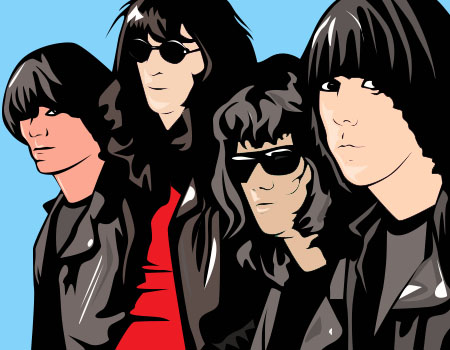
A sound that is now quite familiar — brought to mainstream pop respectability by Nirvana and Green Day — punk rock has blared from movie soundtracks, television commercials, cartoons, and even children’s records (remember Chipmunk Punk?), for nearly four decades. But, there was a time when it was truly fresh; so fresh, in fact, that post-hippie Boomers from the 1960s found it vile, threatening, or simply ugly. In the current postmodern swamp of pop music, I find it difficult to articulate what it once meant to hear a music so new that one could not remember hearing anything like it before. Of course, in retrospect, one scrambles to find precursors and lineages; some form of artistic or intellectual genealogy; some tradition to which the new thing belongs. That doesn’t obviate the initial impact: one listens transfixed; one feels transformed. That’s what happened on a summer’s night in 1976, when, having already visited CBGB’s in the Bowery to sit at the feet of Talking Heads, Television, and Blondie, I at last acquired the first album by the band everyone admitted the CBGB scene was really all about; what everyone meant by “punk rock”: the Ramones. [1]
The Ramones did have “precursors,” most of whom they were willing to acknowledge: Iggy and the Stooges, the New York Dolls, the Velvet Underground (first two albums), as well as singles from Britain, primarily David Bowie’s “Rebel, Rebel” and Black Sabbath’s “Paranoid,” not to mention the myriad “one-hit wonder” garage bands of the early ’60s. But locally, when they first appeared in New York City in late 1974 and later nationally, when their first album blasted into record stores in 1976, it was quite clear that something new was happening in pop music, something that had little to do with the folksy flowers and love-beads of the counter-culture of the 1960s, or the bloated orchestral flourishes of the “progressive rock” of the early 1970s. Clocking in at less than a half-hour, the fourteen tracks of the first Ramones album were minimalist sonic booms of three-chord chainsaw guitar; rumbling, rapidly fingered bass; thundering, metronomic drums; quavering, choked out vocals reciting as few lyrics as could convey an idea and suggest (not necessarily tell) a story. This suggestion of narrative is what I’m concerned with; it explains how the Ramones were able to get away with delving into the darkest, dirtiest depths of their collective consciousness and yet sound like one of the lightest, most entertaining throwaway pantomimes of what some teen-ager might imagine a rock band to be. The Ramones are the comic book version of Lou Reed’s speed-driven “White Light/ White Heat,” the living cartoon versions of the sexually angst-ridden narrators of “Rebel, Rebel” and “Paranoid;” the Warner Bros.’s Animation version of the Stooges’ “No Fun.” Which doesn’t mean that there isn’t a real pain achieving expression in their songs. There is, maybe, even too much of that. Perhaps that is the very reason their songs lurch into the realm of caricature. The Ramones hurt so much that reality reduces into comedy at every level: in their minimalist composition; their thought-balloon’ lyrics; the undeniably humorous-ironic presentation in concert (“Gabba Gabba Hey!”). Nobody could take the Ramones seriously. What better way to hide the outrage and pain of their existence?
We need to begin with — and later return to — the personalities. The original Ramones might be said to be culturally and politically schizoid. Guitarist Johnny (Cummings) Ramone and bassist Dee Dee (Colvin) Ramone were of Celtic (Irish, Scottish) Christian origins, although Dee Dee also had a German mother. Both were firmly to the political right. Drummer Tommy (Erdelyi) Ramone and singer Joey (Hyman) Ramone were of East European Jewish descent and were to the political left. On the other hand, as far as personal stability is concerned, the schizoid cleft followed a different line: Both Tommy and Johnny were cool, businesslike (at first), and professionally ambitious. Johnny especially could be tough minded about “the job” of playing rock music (perhaps too tough minded). Dee Dee and Joey were both shy and withdrawn. In their later teens, they’d both been kicked out of their homes. For Dee Dee, physically abused by his alcoholic father (a soldier stationed in Germany), finding himself on the streets of New York was just another moment in a seemingly endless trauma. He briefly became a male prostitute in order to survive. Joey’s experience was almost as bad, in a different way: bullied at school, he developed a punishing Obsessive-Compulsive Disorder (think Tony Shalhoub’s Mr. Monk, only without the sympathetic irony and occasional laughs). What Dee Dee and Joey shared was a certain romanticism. Both had artistic rather than business-oriented ambitions and sought recognition for their art, not just financial success.
These personality differences would have a profound impact on the group’s professional relationships. By the 1980s, after Tommy had been replaced by Marky (Bell) Ramone, the band entered a phase during which they hardly spoke to each other, even while sharing the same van during touring. Actually, calling it a “phase” is being too cautious. It lasted the remainder of their lives. Despite the “legend of the Ramones” as perpetrated by favorable critics, fans, and occasionally laced into their own songs, they did not originate as a group of friends hanging out in the Forest Hills neighborhood of Queens. They didn’t like each other, and they weren’t even all that musically compatible. The Ramones were a concept band – they developed as the embodiment, the sound of what, in some other world, a rock and roll band could have been and should have sounded like. As though the ’60s had been largely skipped over, and the Kingsmen’s “Louie, Louie” (1963) had been followed the very next year by Sabbath’s “Paranoid.” Woodstock never happened in the Ramones universe, and Mussorgsky, what was he, some commie? Isn’t Emerson, Lake and Palmer an ambulance chasing law firm? Part of the Ramones schtick was feigning ignorance, but this feint hid an embarrassment. The Ramones lacked any real formal education. Whatever they knew, they’d picked up listening to others. In later years, Joey (beyond an encyclopedic knowledge of his record collection) developed as an auto-didact, with the spotty knowledge one could expect from such. Dee Dee painted obsessively, but without any training or exposure to artists beyond the hot-house of the chic NYC art scene. The best one can say of his work is that it’s “original,” which is not necessarily a compliment. As for Johnny, he didn’t care, and Tommy was more concerned with the business-end of things. The Ramones were the poets for those who’d dropped out of school in the eighth grade. “Now I wanna’ sniff some glue,” because having too many brain cells is for losers.
Calling the Ramones a concept band opens the door to unnecessary criticism, as though we were entering the territory of the Monkees or the Archies or more recently, the Spice Girls or K-Pop. But this is to think in critical absolutes. There’s nothing wrong with being a concept band any more than there is in constructing “concept art,” like Warhol’s Brillo Boxes. The Crucifix is concept art: dropped into a culture with no familiarity with Christianity, it would simply be the representation of an executed criminal. The question is always, does the concept work within its cultural context? Does it evoke the intended emotional and intellectual responses? And does it adequately embody the concept? Is it aesthetically what the audience expects and desires from the representation? If the answer to this question is positive, then we’re confronting a work of art (and so much for Heidegger, who should have paid closer attention to Hegel). Any lapse only produces kitsch, worthy of plastic representation on a dashboard or lawn ornament, but hardly worthy of critical comment. Raphael’s “Madonna and Child” good; plastic Jesus not so much. And here, of course, we find the real genius of the Ramones: they are plastic Jesus filling the space of “Madonna and Child,” as pop music devolves into the niche-genre swamp. Except that this hadn’t happened yet. They are thus among the important precursors of the music scene in which we find ourselves today. They established a niche – “Ramones music” – that only they could fill.
___
Ramones, the band’s first album, is not really a concept album (although it has a frame in the first and last songs, which we’ll get back to), but there are themes that recur and pop out at us. Perhaps the principle of these is that the apparent love songs on the album are about yearning for love, or about a violent breakdown of a relationship, or about the memory of a failed coupling. There are no songs celebrating being in love; about being in a relationship at a present moment. They’re not love songs so much as they ask the musical question, “could there ever be any such thing as love?” And the answer seems to be “no,” although you and your significant other can go to ‘Frisco, join the Symbionese Liberation Army (like Patty Hearst), and perhaps die. Yet these “anti-love songs” are written with the same simplicity and primitive poetics as the love songs of the great garage-bands of the early ’60s. One of the Ramones’ most important creative decisions (apparently shared between principle songwriters Joey and Dee Dee) was to push garage-band formulas to the border of self-parody (and frequently beyond). That raises interesting questions. ’60s garage band songs were never intended to be taken seriously. Their writers were not aspiring, misunderstood artistes. They were teenagers with too much testosterone, celebrating their first relationship on the dance floor. Their songs were primitive, nearly parodic imitations of the more sophisticated love songs of jazz or swing, the more adult, openly sexual love songs of the Blues and Country/Western. So how does one parody a near-parody? Actually, Harvey Kurtzman figured this out back in the 1950s, exhibiting his solution regularly in the nascent Mad Magazine, and even after he left it, the magazine continued in his tradition, and does so largely to this day. Mock the mockery as though it took itself seriously. Turn every image into a caricature. Reduce personality to stereotype. Distill stereotype to stick-figure. Dialogue dumbs down to unreflective malapropisms. The imitation of life requiring suspension of disbelief becomes a cartoon utterly detached from the problem of belief. One paradigmatic instance of this is Kurtzman’s brilliant rip of the old Batman comic book, “Batboy and Rubin,” recently immortalized in an episode of (appropriately enough) Batman: The Brave and the Bold (“Bat-Mite Presents Batman’s Strangest Cases”) [2]. The story ends when Rubin discovers the real master-criminal is Batboy, who then beats Rubin to death. The parody of near parody almost always leads to violence: the problem of belief or its suspension has to be shattered in no uncertain terms. The audience is reminded not to sympathize with such characters. The shadow play only comes to life when heads literally explode. Perhaps this partially explains another recurrent theme on the album. When the experience of adolescence is confronted directly, it is presented in horrific terms: “Beat on the Brat” (supposedly based on a real incident Joey witnessed); “I Don’t Wanna Go Down To The Basement” (“something down there” — possibly Dee Dee’s sexually abusive father); “53rd and 3rd” (Dee Dee’s autobiographical reflection on life as a male prostitute). The only quality of youth that makes it barely livable is the very absurdity of it all: “Basement” seems to reference an old z-grade horror movie, and the seriousness of “53rd and 3rd” is undercut by the singer’s insistence that “I’m no sissy.” “Sissy“?! Good heavens; monetized sexual deviance and murder reduced to schoolyard boasting.
Which finally brings us to the most controversial theme embedded in the album, specifically in its first and last songs (“Blitzkrieg Bop” and “Today Your Love, Tomorrow the World”): Nazism. The resurgence of right-wing populism, which conservative politicians long encouraged, and which has achieved its apotheosis in the US with the Trump presidency, inevitably included the resurgence of anti-Semitism. Many conservatives didn’t see that coming, especially since there are Jews on the far Right, like Trump adviser Stephen Miller. These may be racist, but surely, they couldn’t be anti-Semitic. Nonetheless, that anti-Semites would enjoy increased legitimacy in the current era was, as noted, inevitable. The fears populist demagogues play upon are actually vague and amorphous. It is up to the demagogue to give them substance and identity: any will play as well as any other. Anti-Semitism has a long and durable history, with many motivations accumulating over the centuries, and it is easily resurrected. Consequently, it is now difficult to remark a time, in the early ’70s, when the horrors of WWII and Nazism and the Holocaust were widely understood as so aberrant, their initial motivations so sick, that only loonies on the margins of the far Right could ever imagine their viability as political choices in an ever increasingly pluralistic American culture. But I remember that time, when as an undergraduate in Westchester County, I could hear Jewish classmates tell a joke that now appears so reprehensibly anti-Semitic. I can only say that it involved pizza. Why would they do that? Because at the time they – we – were certain that the Holocaust was ancient history; that it’s motivations would always remain buried at the margins; that Nazism was merely the ghost that haunted a once defeated, now long rehabilitated, Germany. Ah, well, the naivete of youth.
At any rate, we can now see how Dee Dee is using the first and last songs on the album to reference his own youth on a US military base in Germany, and why the Jewish Joey would be willing to sing these songs. Interpersonal violence (“shoot ’em in the back,” the line Dee Dee contributed to Tommy’s “Blitzkrieg Bop,” along with the title) and world war take the place of realizable relationships with others. Empty boasts replace vulnerably honest communication. Douglas Colvin and Jeffrey Hyman were real human beings, with real fears and hopes. Dee Dee and Joey Ramone are Mad Magazine caricatures: script by Harvey Kurtzman, art by Wally Wood. Johnny gave them the sound that numbed the pain; Tommy gave them the backbeat to bring it to the dance floor. Pain becomes pose, pose becomes lifestyle, lifestyle becomes comic book, comic book becomes music. “Hey ho, let’s go!”
The only instrumental solo on the whole album is guest Craig Leon’s electric roller-rink organ riff on the cover of Chris Montez’ “Let’s Dance,” the only song on the album that is truly celebratory. Notably the solo is buried in the mix, so one has to listen carefully for it. And listening carefully to Ramones music is not easy. It’s more fun when allowed to rush over one in waves of sound while bouncing up and down in a pogo. For some, that’s all to be hoped for from life. But perhaps, it’s enough.
Notes
[1] https://en.wikipedia.org/wiki/Ramones; https://en.wikipedia.org/wiki/Ramones_(album); 2016 remaster: https://www.youtube.com/watch?v=p00fxoDpaIo
[2] https://en.wikipedia.org/wiki/Harvey_Kurtzman; https://jeffoverturf.blogspot.com/2011/07/bat-boy-and-rubin-wally-wood-mad.html; Batman: Brave and Bold / “Bat-Mite Presents: Batman’s Strangest Cases:” https://www.youtube.com/watch?v=vx4xpzvwRzo