When it comes to philosophies of art – theories about what art is or what defines ‘art’ – I have distinguished between “traditional” theories and what I call the “New Wave.” The former, which includes Representationalism (art is “mimesis”), Expressivism (art is the communication of emotions by way of media), and Formalism (artworks are things that have “significant form”), define art in terms of its observable or manifest characteristics. But, then came the Avant Garde. If abstraction stripped art down to its most fundamental observable characteristics, meaning its formal properties, artists like Marcel Duchamp and Andy Warhol went beyond the observable and presented ordinary objects as artworks: in Duchamp’s case, an actual urinal (and in another instance, a snow shovel) and in Warhol’s case, simulated Brillo Boxes, which were made and displayed so as to be indistinguishable from those one would find in a store.
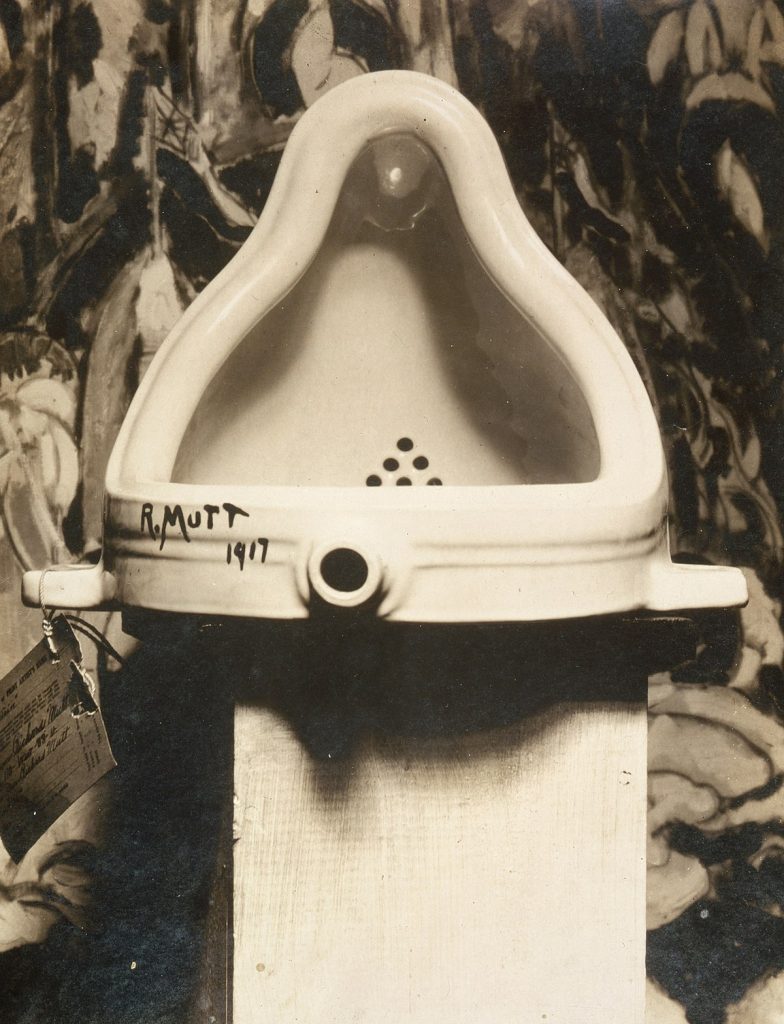
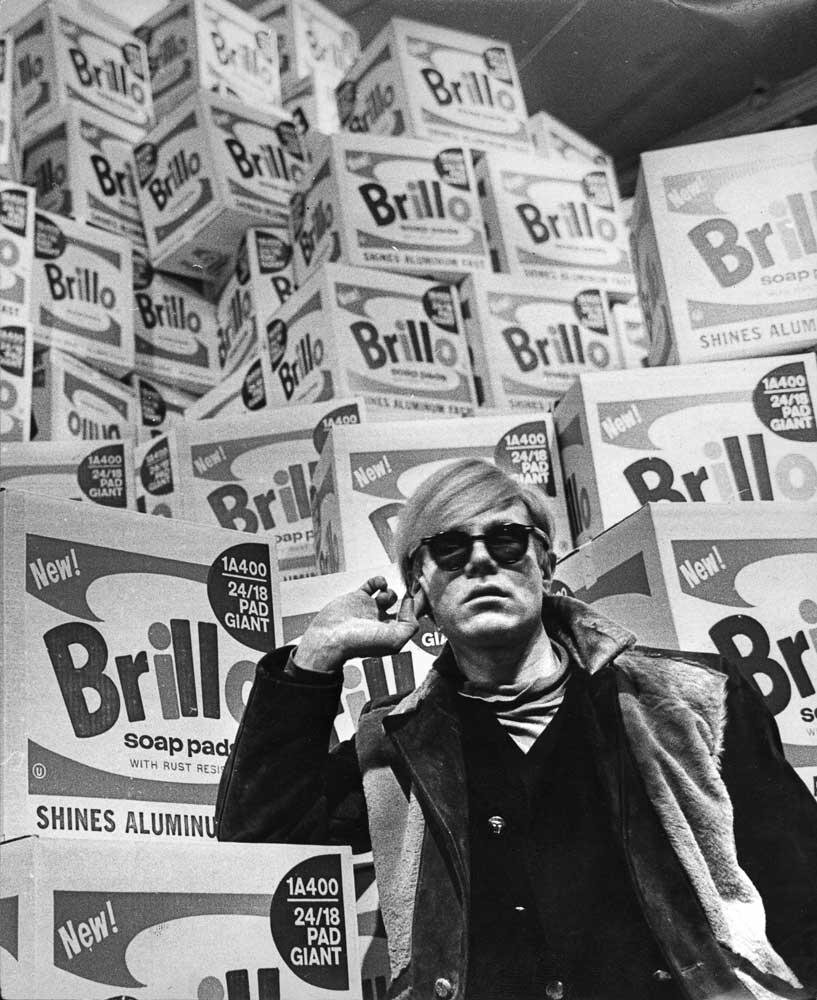
Marcel Duchamp, Fountain (1917) [L]; Andy Warhol, Brillo Box (1964) [R]
These posed a problem for the philosophy of art. If the aim is to develop an account that distinguishes art from non-art, then what happens when one and the same thing can be an artwork on one occasion but not another? What distinguishes Duchamp’s urinal, which is art, from another perceptually indistinguishable urinal that is not?
In the business, this is known as the “Problem of Indiscernibles,” and it produced a crisis in twentieth century philosophy of art; one strong enough to convince a generation of philosophers that ‘art’ could not be defined. These philosophers tended to be Wittgensteinians, who included ‘art’ alongside other concepts that seemed to defy analysis in terms of necessary and sufficient conditions and who were inclined towards “anti-essentialism” in metaphysics more generally. In their view, whether or not something is art is a matter of whether it bears sufficient “family resemblances” to those things that are already deemed art; nothing more and nothing less.
It wasn’t long, however, before people began to wonder whether this was all a bit hasty. After all, one can easily think of terms that cannot be defined with regard to the manifest or observed qualities of their referents, but which are definable nonetheless and require no foray into family-resemblances. Uncles, for example, may be fat, thin, tall, short, hirsute, bald, etc., but this doesn’t mean that ‘uncle’ is undefinable or that whether or not someone is an uncle depends on whether he suitably resembles other uncles. This is because ‘uncle’ is defined relationally, in terms of being a male sibling of one’s father or mother. Indeed, this was precisely the point Maurice Mandelbaum made in his 1965 paper, “Family Resemblances and Generalizations Concerning the Arts,” and it led to a new crop of theories: the aforementioned “New Wave.”
Rather than define art in terms of observable or manifest characteristics as traditional theories had done, these new accounts did so in terms of artworks’ relations: to institutions (the “Institutional Theory of Art”); history (the “Historical Theory of Art”); or in Danto’s case to interpretations, which effect what he calls “transfigurations of the commonplace” (in his 1981 book of the same name). And it is this notion of transfiguration and the way in which Danto employs it that I think has a broader significance for metaphysics.
For Danto, what distinguishes the art-urinal from urinals that are not art is that the former is interpretable, while the others aren’t. The same is true of Warhol’s art-Brillo boxes versus the ones you find in the store. And in the case of two things that are artworks, but which are perceptually indiscernible, what makes one the artwork that it is and the other the artwork that it is are their respective (and distinct) interpretations. At the beginning of The Transfiguration of the Commonplace, Danto imagines an exhibition consisting entirely of perceptually indistinguishable red, square paintings. We are told that one is a still life – “Red Tablecloth” – another is a psychological portrait – “Kierkegaard’s Mood” – while a third is a “clever piece of Moscow landscape,” named, of course, “Red Square.” How it is possible for perceptually identical things to have entirely different interpretations and the conditions for those interpretations are subjects that Danto takes up in Transfiguration of the Commonplace, but also in its follow-up, The Philosophical Disenfranchisement of Art (1986). I have argued for metaphysical pluralism (in contrast with monism and dualism) on the grounds that our social ontologies (things like persons, institutions, and states) demand it, and it occurred to me that Danto’s metaphysics of art points in the same direction and in a clarifying fashion. To see this, let’s take an example, the Florentine Pieta, by Michelangelo.
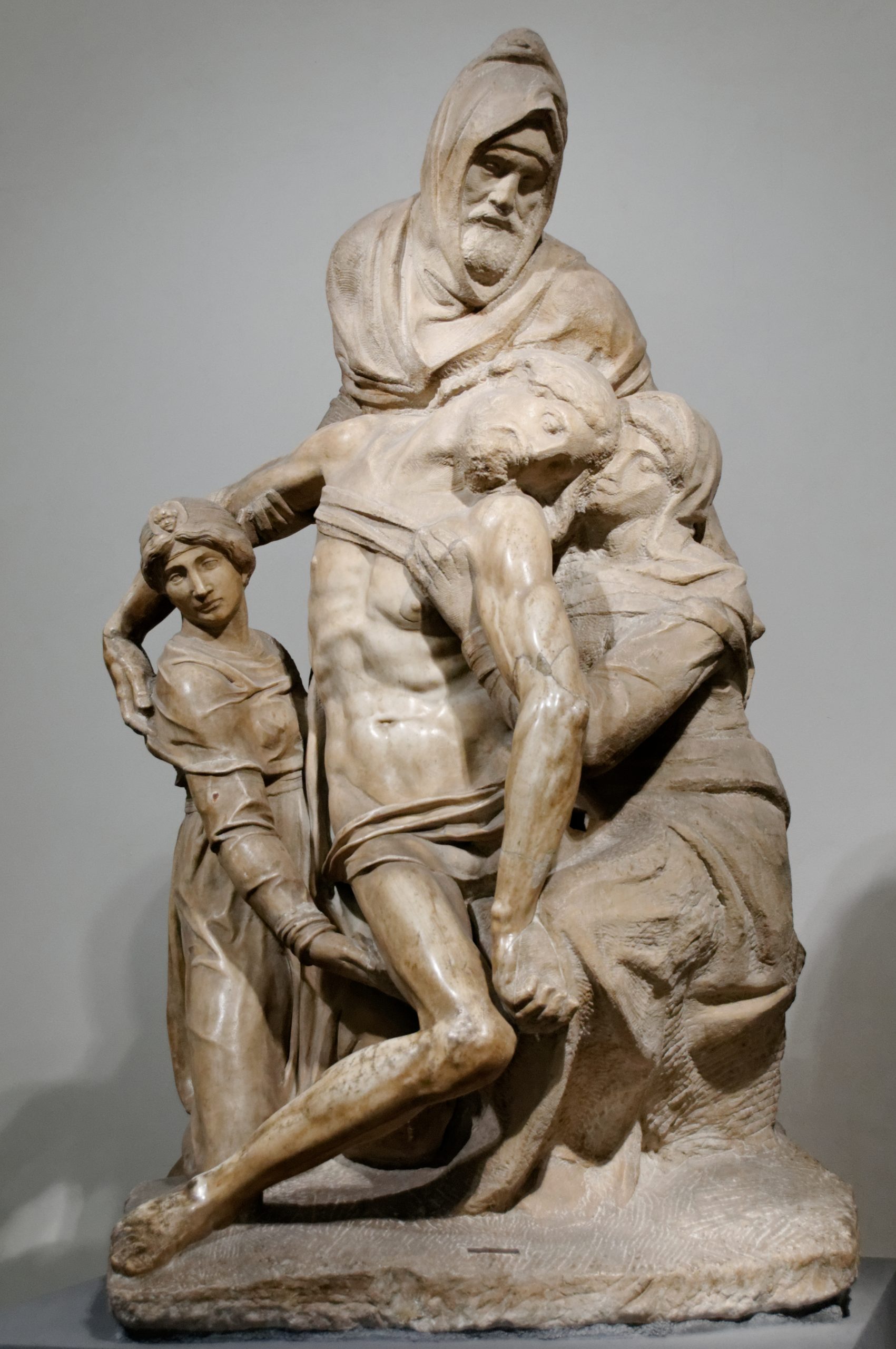
Michelangelo, The Deposition [aka the “Florentine Pieta”] (1547-1555)
Suppose I point to the right shoulder of Nicodemus, and say “that is Nicodemus’ right shoulder,” which seems obviously true. Yet, the following is also true: “that is a piece of marble.” And of course, “shoulders are not pieces of marble” is true as well. Now, this would seem to violate the law of noncontradiction, but Danto suggests that it is the result of a peculiarity in the logic of the ‘is’ of artistic identification. That logic is transfigurative, rather than indicating a simple identification, as the term ‘is’ does when used in other contexts.
‘Transfiguration’ is supposed to be evocative of ‘transubstantiation’, which belongs to Catholic theology and refers to the turning of the wafer and wine into the body and blood of Christ, during the Eucharist. It’s not as if the wafer, upon blessing it, materially turns into one of Christ’s arms or legs or the wine into a cup of blood. Ostensibly, they remain wafer and wine. Between them and unblessed wine and wafers of the same type, there are no perceptible differences. Nonetheless, they belong to entirely different ontological categories: the blessed wafer and wine are Christ’s flesh and blood (in Catholic tradition, this is not understood as a metaphor), so they both are and are not Christ’s flesh and blood; they both are and are not wafer and wine.
Danto wants (partly) to analogize the ‘is’ of artistic identification with the ‘is’ of transubstantiation, and he gives the effects of this ‘is’ the name ‘transfiguration’. It’s not as if through Michelangelo’s efforts, the marble turned into a flesh, blood, and bone shoulder. Yet, it is a shoulder – Nicodemus’ shoulder – and this is not a metaphor, anymore than the claim that the entire statue is Nicodemus is a metaphor. And yet the shoulder – and the whole statue – is also a piece of marble. In the case of transubstantiation, the mechanism of transformation is God-Magic, while in the case of transfiguration, it is interpretation. It is because the whole is interpreted as Nicodemus that it is Nicodemus, and it is because of the place the part occupies in that whole that the part is Nicodemus’ shoulder. But whatever the mechanism of ontological change, what is important for our purposes is that it occurs without any alteration of substrate.
In my Prolegomena for a Pluralist Metaphysics, I maintained that ontological commitment is not hypostatic; that to say “there is a such-and-such” is not to say that such-and-such is a discrete object or substrate; that existence does not imply “thingness,” but has only to do with the truth-conditions of relevant statements. And we can see this very clearly in the case of artworks, as conceived by Danto. There are all sorts of things one can truthfully say about Fountain — or Brillo Box or The Deposition — as artworks that cannot be truthfully said about the urinals one finds in bathrooms, the Brillo pads one purchases in stores, or the hunks of marble one may find in quarries, regardless of what the latter may look like. And none of these truthful statements require that artworks be Forms or Fictional Objects or mereological sums of mental states or whatever other strange entities people think they have to countenance in order to make sense of things existing that are not what philosophers call “material objects”; i.e. tables, chairs, buildings, mountains, and the like.
For some, the idea that language and thought can have this sort of ontological efficacy is mystifying, requiring an extraordinary explanation or account. How does a bunch of people talking “become” a law or a regulation? How can merely thinking something about a snow shovel “make” it a work of art? How can drawing some lines on a map “turn” a region into a municipality or a state? But such things are only mystifying to a person who is already mystified. There is no magic involved in employing the existential quantifier. Saying “there is a ____” is not an incantation that conjures substrates from some insubstantial ether. Using modal operators doesn’t generate alternative versions of planets, people, or palm trees. So, far from being mysterious or “queer” (to employ a Mackieism), a pluralistic metaphysics is exactly what one would expect given the myriad things there are in the world, and the only people who seem to be tripped up by the idea are philosophers and those who one might describe as philosopher-adjacent, like theologians.