Anyone who knows me knows that I am a tennis player and enthusiast of long standing. (I have been playing the game since 1973.) They will also know that I think the game has been in decline, despite the efforts of institutional tennis and tennis media (and contemporary fandom) to convince everyone that Novak Djokovic is the Greatest Of All Time or Serena Williams or whoever else. They are not. And understanding why will go a long way towards understanding the ways in which the game has gone in the wrong direction.
But first I want to say something of a more general nature about sports, because my criticisms of the current state of tennis are situated among more general considerations about the nature and purpose of competitive, spectator-oriented athletics. Relatively speaking, human beings are not physically impressive. Any number of animals are faster (e.g. cheetahs), stronger (e.g. bears), more agile (e.g. gazelles), and more dexterous (e.g. monkeys), and for this reason, the “pure” sports – running, jumping, weightlifting, and the like – are of the least interest to me. How impressive is it really to be the “World’s Strongest Man” or UFC champion or some other such thing, when the feeblest orangutan or gorilla can rip your arm out of its socket without any effort? Or to be the world’s fastest woman, when the slowest gazelle or cheetah can leave you in the dust? Or the best swimmer, when there are…dolphins?
Where humans impress is in the intersection of our physicality and our intelligence, and consequently, the most interesting and exciting competitive sports are those in which this intersection is being tested. This means games that involve a substantially strategic and tactical approach to the application of physical prowess, and tennis is such a game. Tennis goes back as far as the Tudors, but the game as we know it began just prior to the “Open Era” with the arrival on the scene of a group of Australian players, including Rod Laver, John Newcombe, Ken Rosewall, and Tony Roche, whose style and quality of play laid the foundation for the tennis of today, insofar as they helped the game shed its genteel, clubby identity and became like other professional sports. Especially impressive were the Davis Cup teams Australia fielded from this group under Harry Hopman, who later emigrated to the US and taught at the Port Washington Tennis Academy, where he trained future stars like Vitas Gerulaitis and John McEnroe and influenced the way the sport would be played going forward. Indeed, I was trained at Port myself in the 1970s and 1980s.
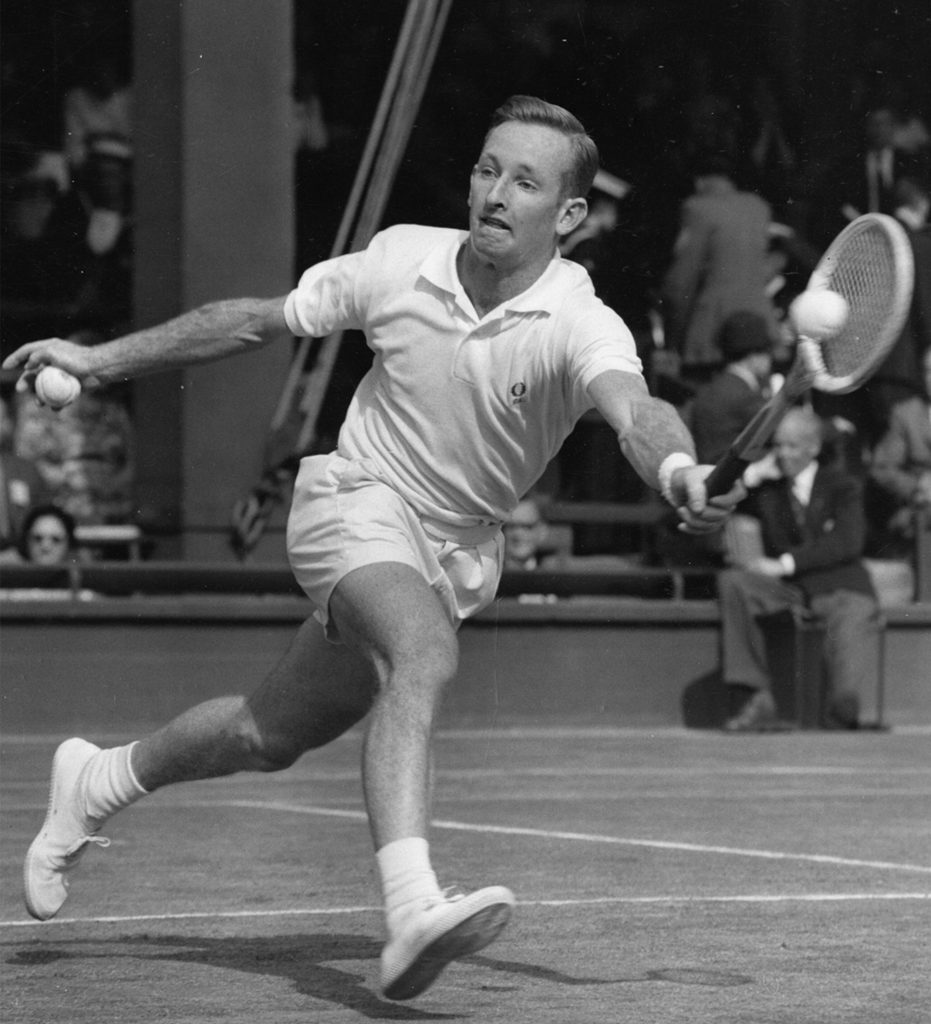
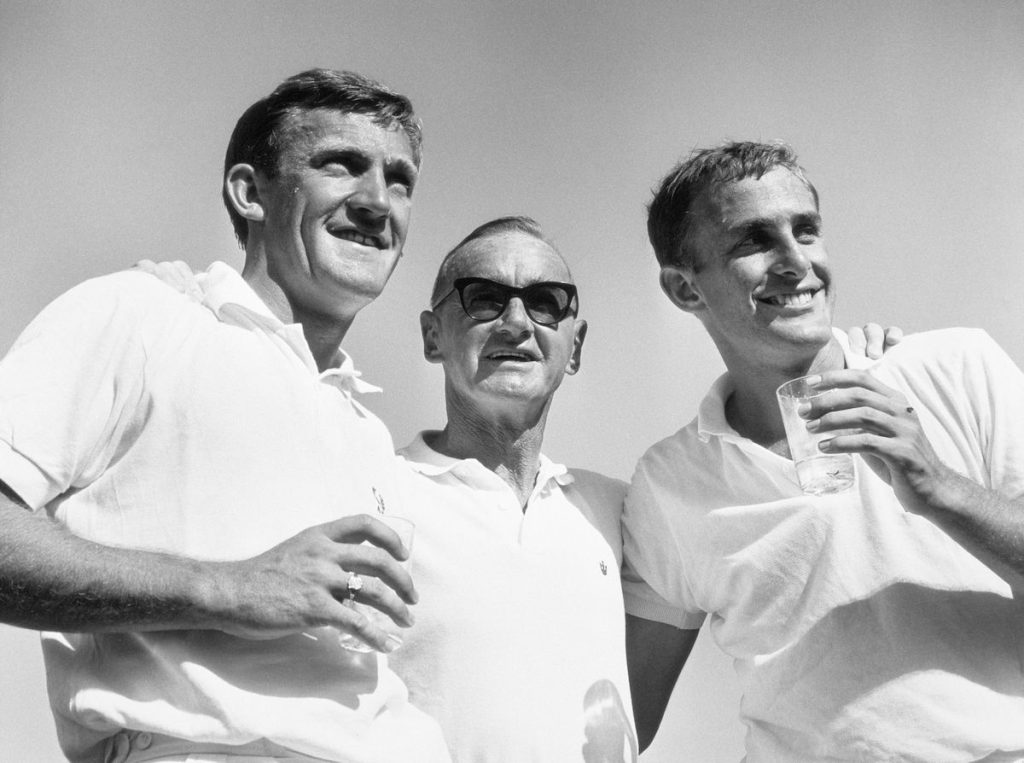
Rod Laver [L] / Tony Roche, Harry Hopman, and John Newcombe [R]
It was an all-court game – baseline, serve/volley, and everything in-between – played on surfaces that behaved so differently that different play styles and tactics were needed to succeed on each. Grass courts played nothing like clay courts, which played entirely differently from hard courts. If a baseline-heavy player wanted to have any chance on grass, he would have to serve and volley, which is why Guillermo Vilas, a legendary baseliner, played an almost entirely serve/volley game in order to beat Ilie Nastase and take the 1974 Masters trophy on grass.
Racquets were made of wood, with small heads (68 inches average), and strung with natural gut strings. With such a small head and even smaller sweet spot, proper form and eyes locked on the ball were a must if one was to hit cleanly and not mishit. Relatively compact swings were necessary – you can’t swing these racquets with the exotic, looping motion of a Rafael Nadal and hit the ball cleanly – so they favored flat and slice strokes over topspin, which meant balls stayed low to the ground, requiring players to remain crouched in order to make their shots. The fact that racquets were composed entirely of natural materials meant that they offered great feel and zero additives: the racquet did what you did and nothing more.
With the introduction of synthetic materials into racquet and string production and with racquet-head sizes expanding radically (to over 100 square inches), racquets today do so much that one expends as much effort controlling them as on tactics and gameplay. With a wood racquet, I can return a hard-hit drive from my opponent with a cream-puff drop shot, if at the baseline, or a drop volley if at the net. With a contemporary racquet, you have to put enormous amounts of underspin on the ball to accomplish this, or else the racquet will spray the ball out of bounds. Indeed, one reason why there is such overuse of topspin from the baseline in the current game is to keep the ball in the court, as racquets are so overpowered that balls will sail out otherwise when hit with any pace. You could only hit so hard with wood and gut strings, and it wasn’t possible simply to overpower your opponent. Service aces were much more a matter of placement than sheer speed – compare an ace by John McEnroe to one by, say, Andy Roddick – and you had to construct and set up points in order to finish another player off. This remained true even with the emergence of metal racquets like the Wilson T2000 and the AMF Head Professional, which gave a bit more power, but at the cost of diminished control. (And their head-sizes and sweet spots were consistent with their wood counterparts.)
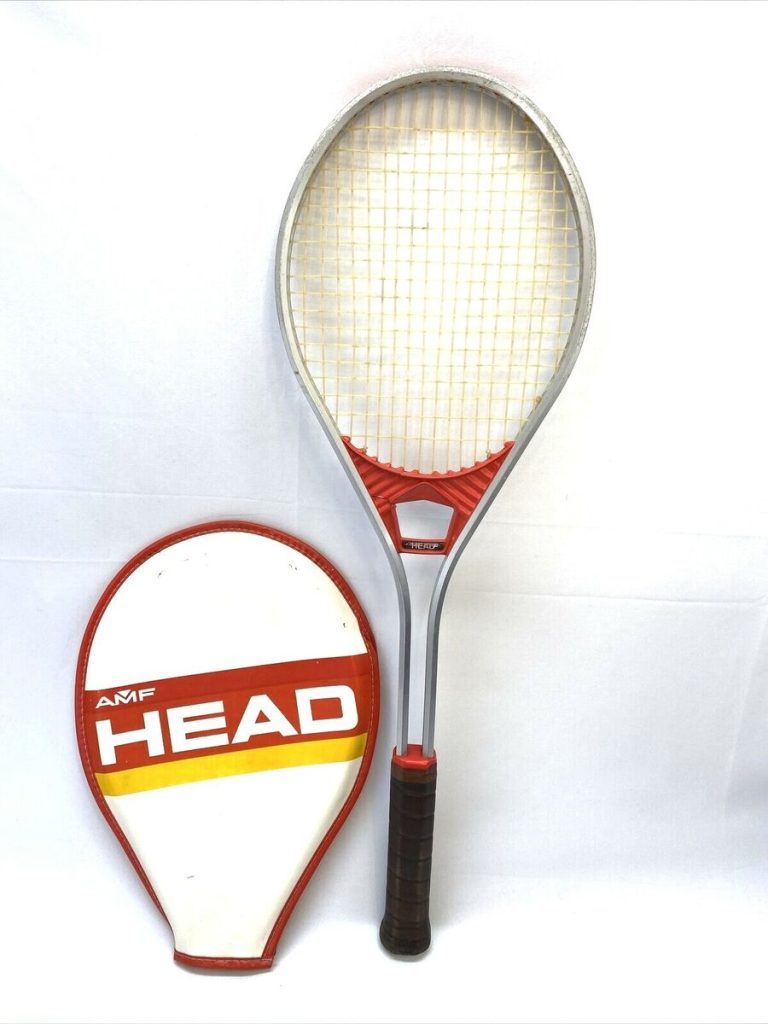
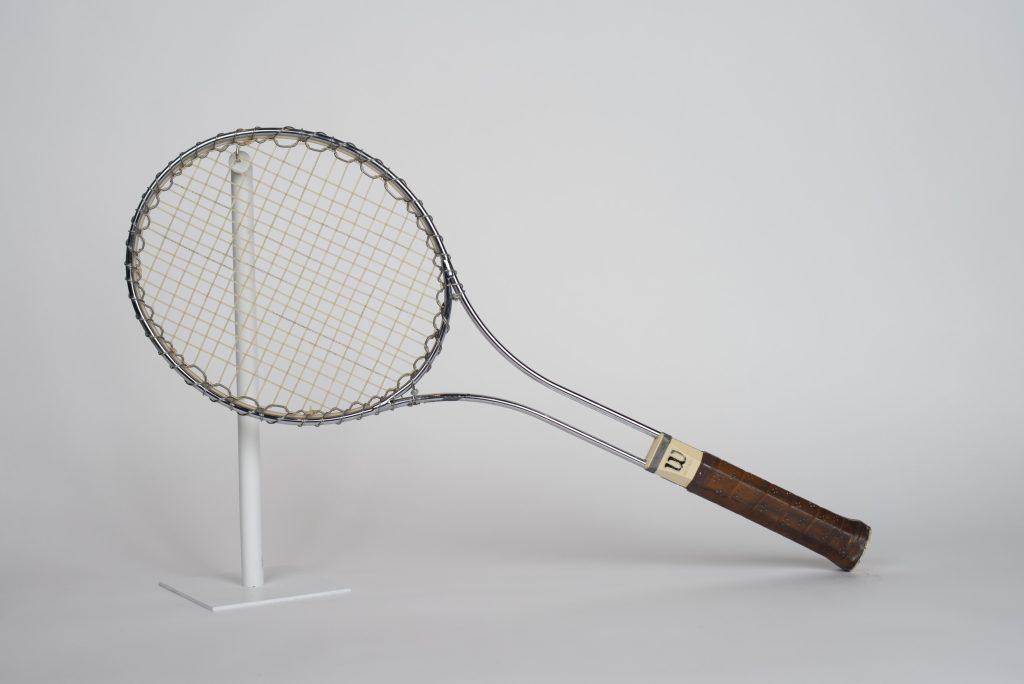
The AMF Head Professional Aluminum [L] / The Wilson T2000 Steel [R]
Court conditions could be rough and treacherous: grass courts would get torn up and full of divots once a tournament had gotten underway, and clay courts were a serious fall-risk if they were too wet or too dry. In this match between Rod Laver and Tony Roche, the court is so tricky that they had to put on cleats (i.e. spiked shoes) midway through, because of the number of slips and falls.
____
This era of tennis – the Open/Wood Racquet era (the 1970’s and early 80’s) – represents the game’s high point in my view. Its equipment and settings and training regimen highlighted the elements that I suggested make a professional sport interesting: it required athleticism, but one could not rise to the highest levels on that alone or even mainly; the very different challenges posed by the different surfaces required one to have not just an A game, but a B and C game as well and a large toolset in terms of the varieties of shots one could hit from different positions; and the fact that racquets and strings did nothing more than what you did meant that you couldn’t just blow people off the court, so the tactical game beat the power game every time. [This last point was made most effectively in the famous 1975 Wimbledon final, where Arthur Ashe defeated the more powerful Jimmy Connors with cunning and guile.]
Things remained relatively stable into the 1980’s even with the shift to graphite racquets in the middle of the decade. These racquets offered more power and somewhat diminished control, but within a range that still demanded tactical sophistication. The next generation played essentially the same game as their immediate predecessors but a little harder and a little faster. The athleticism required also ticked up a notch. But when you watched a Boris Becker, Stefan Edberg or Pete Sampras play, you were watching the same game that had been played by Laver, McEnroe, and Borg; just a bit harder and faster.
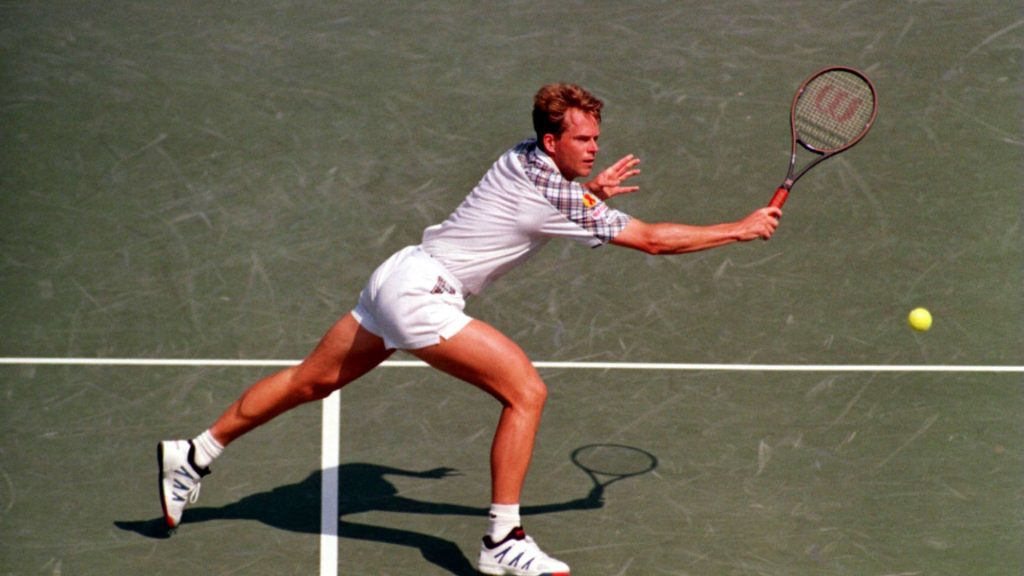
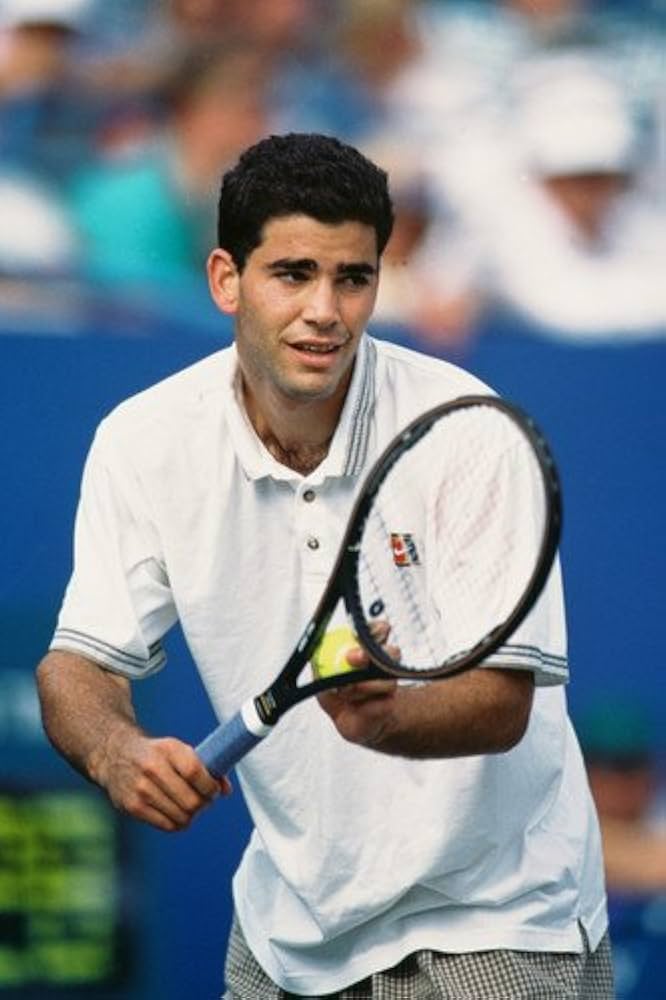
Stefan Edberg [L] / Pete Sampras [R]
But this situation was not to last. The combination of the new, synthetic racquet materials and the increased emphasis on strength- and fitness-training meant that players like Goran Ivanisevic and Mark Philippoussis were serving at speeds that would turn matches into first-serve percentage contests. Get your first serve in and win the point! would not be a recipe for interesting tennis in the 1990’s. So what happened next?
First, the grass court tournaments disappeared. Three of the four Grand Slam tournaments – the sport’s most prestigious events – had been on grass: The US Open; Australian Open; and Wimbledon. For a brief period, the US Open became a clay (Har-Tru) tournament, but then both it and the Australian Open switched to hard courts. Today, two of the four Grand Slams are on hardcourt surfaces, one is on [red] clay, and just one is on grass.
Second, the grass that remained was made substantially slower and hardier, meaning that it played more like the other surfaces in terms of speed and bounce, and the courts would remain in a far more pristine condition, even well into a tournament, eliminating most of the damage that would make grass courts such a treacherous and difficult surface to play on. You’ll never see grass courts today torn up like they were in earlier eras.
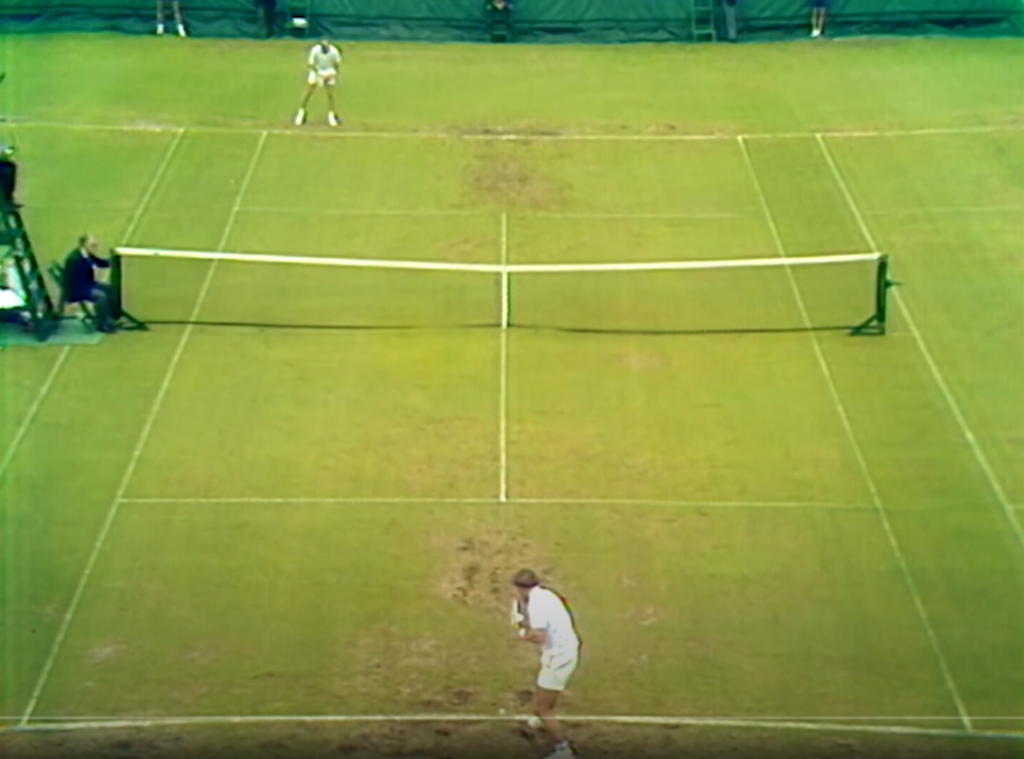
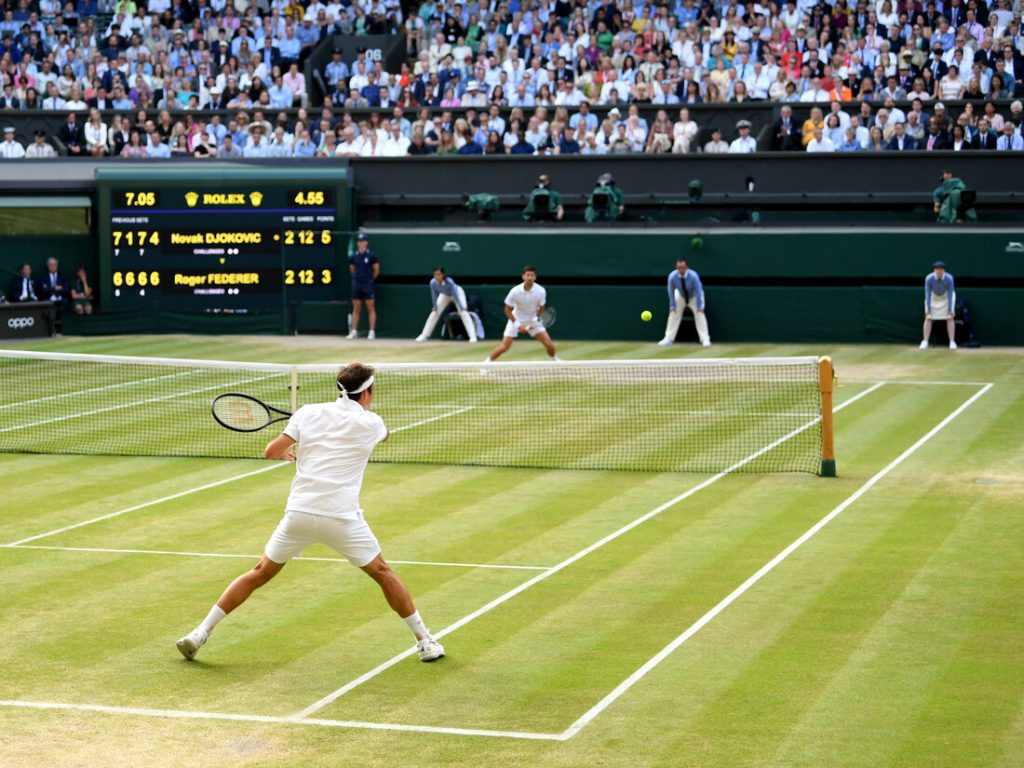
The grass then [L] / The grass now [R]. The match on the left is the infamous Roche/Laver US Open, in which the players donned cleats.
Finally, racquet material technology and design advanced even farther, and a new generation of synthetic strings that “grabbed” the ball made it possible to hit groundstrokes at an extraordinarily high pace without missing, so the former tradeoff between increased power and diminished control was largely mitigated.
When combined, these developments resulted in a radical change in the game. Serve and volley was halted in its tracks, as the slower surfaces and super-powerful racquets and grabby strings made a big serve not only much easier to return, but made child’s play out of completing passing shots against an approaching volleyer. And while the grabby strings made it much easier to keep the ball in the court while blasting it a hundred miles an hour from the baseline, the stiff, brittle quality of the synthetic materials and the wildly elevated pace of play reduced shot variety to just a handful of viable shots and made setups very hard to pull off. Add to the mix the similarity in the way the surfaces played, and the game devolved into a baseline bash-and-grind that rewards fitness and consistency above all else. So, with the exception, perhaps, of the modern game’s lone genius, Roger Federer, it is no longer the case in tennis that tactics trump power. Indeed, quite the opposite is true: in tennis, today, power (and fitness) trumps tactics nearly every time. The balance between physicality and intelligence that I spoke of earlier has become skewed heavily towards the former and away from the latter, and as a result, the game has been diminished, something that is reflected in decreased public interest, the height of which was in the 1970’s and 80’s, when the top players enjoyed celebrity well beyond the tennis world.
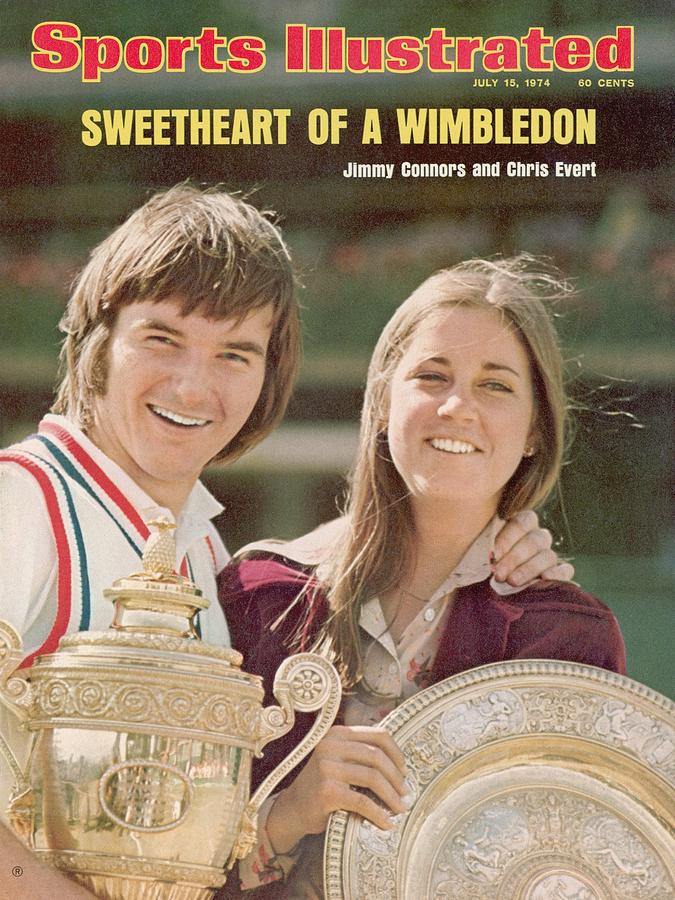
The short-lived romance between Jimmy Connors and Chris Evert had the world’s attention.
___
I haven’t said anything yet about the women’s game, which underwent roughly the same trajectory but suffered even worse effects. Lacking the physical strength, endurance, and speed of the men, women’s tennis had been even more tactical and shot-selection rich and felt like a different game than the men’s: slower, more patient, and more dependent on precision, skill, and smarts. There has never been a better baseliner (of either sex) than Chris Evert who, in her prime, could hit a dime anywhere on the court, and there never was a player as impressive and balanced, overall, as Martina Navratilova. The rivalry between the two remains the greatest in the history of the sport.
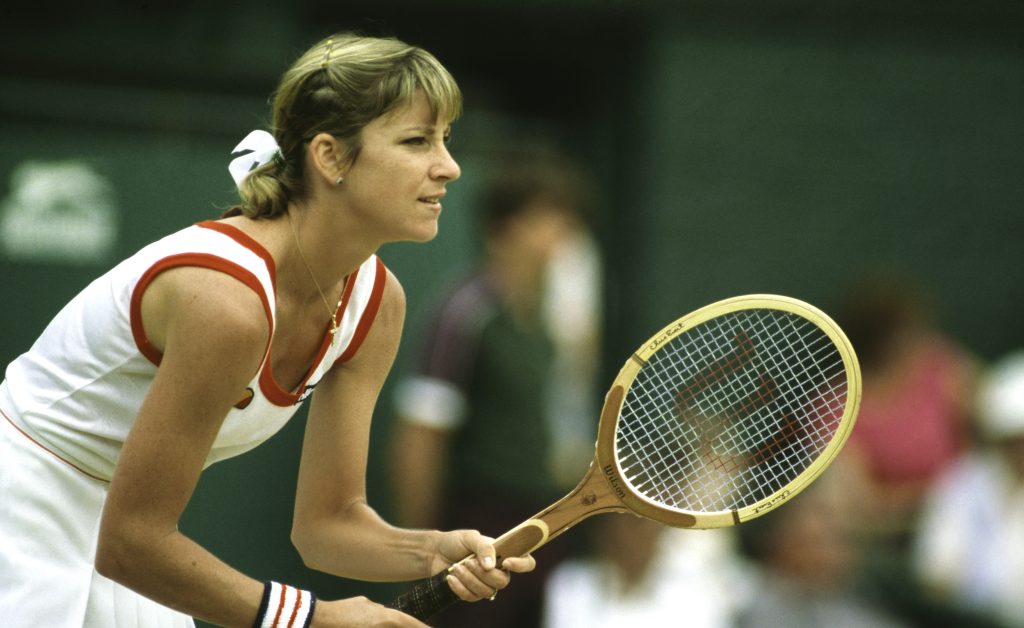
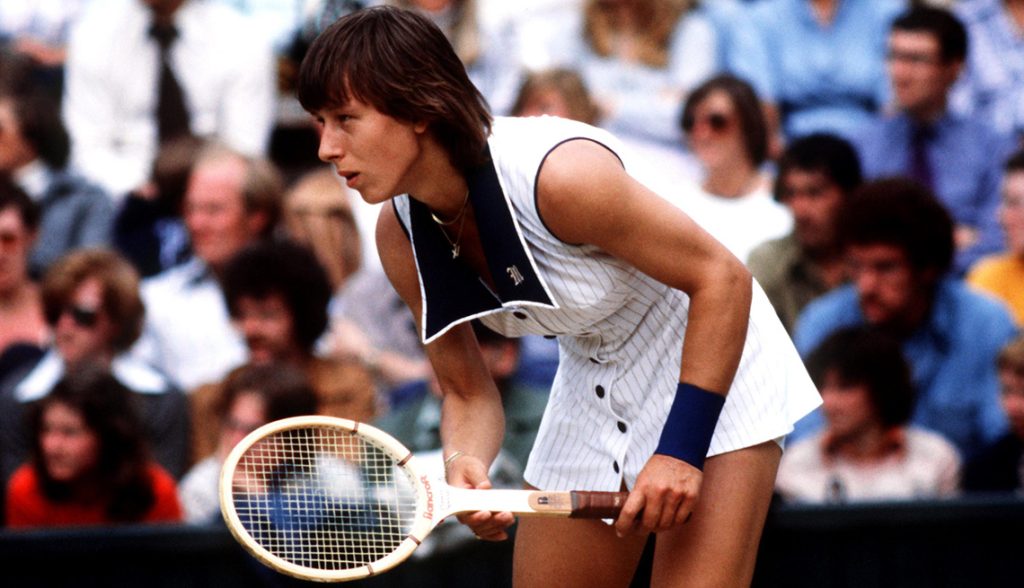
Chris Evert [L] / Martina Navratilova [R]
Because women’s tennis was so tactical and dependent on shot-selection, the impact of the synthetic racquet/string revolution, changes in court surfaces and increased emphasis on fitness did even more damage to the women’s game than they did to the men’s. Power became everything, beginning with Steffi Graf and Monica Seles, but it really hit its game-destroying peak with the dominance of Serena Williams, whose physicality and strength were so overwhelming that the same bash-and-grind-game into which men’s tennis had devolved became even more prominent on the women’s side. And now that Serena has retired, it’s become painfully clear that women’s tennis today is little more than an inferior version of the men’s game.

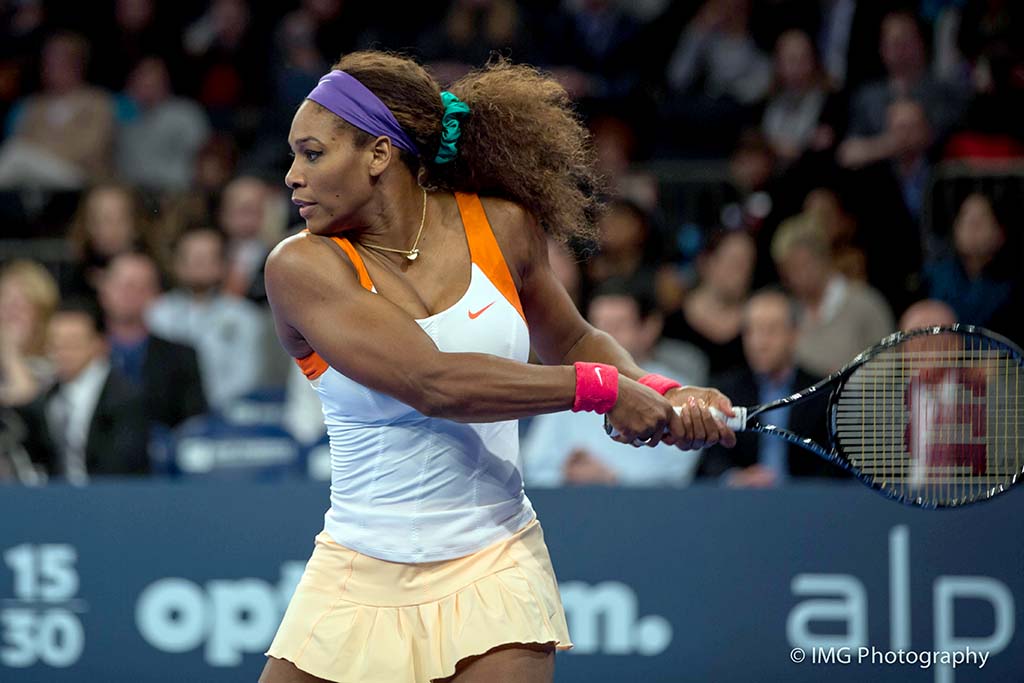
[L] Steffi Graf / [R] Serena Williams
____
Returning to the question of “Greatest of all Time,” it should be clear at this point why such assessments are baseless. How could one possibly tell who is a better player, Bjorn Borg or Novak Djokovic or Rod Laver or Roger Federer, unless one could see how Djok/Roger would have played with the old equipment and on the old surfaces or how a young Borg/Laver would have played with and on the new ones? Given how much more difficult the game was with the earlier equipment and on the earlier versions of the court surfaces, if we are to guess, the presumption has to be in favor of Borg/Laver. In my own play, I switch every few months between wood and contemporary racquets, and the difference in difficulty is demonstrable. Beyond narrowing and shrinking the game, the new racquets and strings have also made it easy for players to develop lazy swinging and court-positioning habits. They allow you to get away with things that you cannot get away with playing with wood. And don’t even get me started on what it would be like to try and play on a grass court in the condition of the one on which Laver and Roche played at the 1969 US Open. It is my view – one in which I’m joined by John McEnroe – that tennis made a mistake in allowing oversized racquets and synthetic frames and strings, which set in motion the changes to the sport that we have been talking about. Major League Baseball did not make this mistake when it found itself with a similar challenge – high-quality metal bats – and for reasons of both safety and quality of gameplay, MLB remained wooden bats only. If professional tennis had done the same – required racquets and strings to be made of wood and gut with a standardized, small head-size – it might have avoided arriving at the unenviable spot it finds itself in now.