by E. John Winner | Jul 4, 2026 | Essays on Popular Entertainment and Culture
Popular music has become a swamp, with sinkholes and tangled underbrush. Every musical form can now be considered “niche” music — not shades along a spectrum, but a patch in a crazy quilt of vaguely related or wholly unrelated sounds and lyrical stylings. Strangely, it was once possible to imagine a single history of popular music: from carnival rants and pub songs, sailor chanties and cowboy plaints, through minstrel shows and Tin Pan Alley throwaways, then receiving a massively regenerative historical diremption with the popularization of music made by descendants of Africans brought to America as slaves, occurring simultaneously with, and in large part due to, the technological innovations of recorded music performance. This initiated all of the major genres of American music played in the 1960s: jazz and swing; country and folk; blues and soul; and of course, rock and roll, which engulfed everything else.
These genres seemed to play off each other dialectically, to such an extent that by the late ’60s the future of pop music seemed utterly predictable, and indeed evolved unsurprisingly into the ’70s with occasional side-steps and expanding inclusion of already existing music forms. When Emerson, Lake and Palmer performed Mussorgsky’s “Pictures at an Exhibition,” it seemed as though Rock could achieve the perfect synthesis of all musical forms. Of course, music specifically made by and for Black Americans (“R&B” – rhythm and blues) was developing some alternative forms (most notably Disco), it was generally assumed that such developments were running parallel to those in Rock, and R&B and Rock would play against one another until achieving a final synthesis in a Rock idiom, as Rock had already sucked much of Black music into itself. So far, so Hegelian. But there’s a reason why Hegel characterized the arrival of Romantic poetry as the end of poetry, or why, reading Danto in a certain way, one can say of Post-Modern art that it is really the end of art; the end of any history of art that would make sense of it qua historical narrative. It is that such a narrative ought to end “happily ever after.” As prophesied by Whitman (surely the exemplar of the post-poetry poet), everyone would become his or her own poet. Well, that’s actually how it does end, but it can only happen if there is no cultural center, no shared standards of values; no “happily ever after.” If some teen-agers record the scraping of chalk across a blackboard and they can get other teen-agers to dance to it, we’ll need a new category for Billboard Magazine: Chalk-Pop.
The final synthesis of the dialectical history of pop music did not arrive in the Rock idiom, but in Rap and Hip-Hop in the early ’80s. Not by embracing all other music forms, but by smashing them, and then scratching the samples together on turntables, while lyricists recited lines rather than singing. Originally derived from elements of Disco and Reggae, Rap and Hip-Hop adamantly refused every interest or value of the pop music that had come before, except that of dance. (I’ve seen intellectualist defenses of Hip-Hop as “African this” and even “Blues that,” but it’s all crap. Shake yer booty or take it off the dance floor.) Lyrically, nuance and subtlety – previously the qualities most admired in the work of pop music lyricists – were tossed to the wind, replaced with explicit expressions of desire, anger, or fear. Surely, everyone wants sex, everyone wants to get high, and everyone wants power, so why hint at it, when you can say it outright? That doesn’t mean we can’t get good music or interesting lyrics anymore, but these no longer arise as progressive developments from pop music’s history: that story is done. Of course, we still have young lyricists imitating Bob Dylan or Joni Mitchell or hoping to achieve the influence of Laura Nyro or Stevie Wonder. That’s inevitable in a fragmented culture — the yearnings of the past never fully lose themselves in the satisfactions of the present. Not so long ago, buskers in Boston could still be heard warbling the Middle-English “Twa Corbies.” Any music will find its audience, but no particular music moves its audience towards any future other than “more of the same.”
___
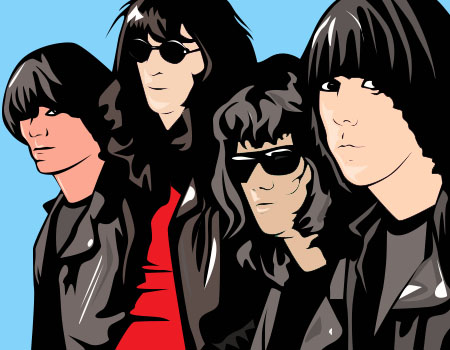
A sound that is now quite familiar — brought to mainstream pop respectability by Nirvana and Green Day — punk rock has blared from movie soundtracks, television commercials, cartoons, and even children’s records (remember Chipmunk Punk?), for nearly four decades. But, there was a time when it was truly fresh; so fresh, in fact, that post-hippie Boomers from the 1960s found it vile, threatening, or simply ugly. In the current postmodern swamp of pop music, I find it difficult to articulate what it once meant to hear a music so new that one could not remember hearing anything like it before. Of course, in retrospect, one scrambles to find precursors and lineages; some form of artistic or intellectual genealogy; some tradition to which the new thing belongs. That doesn’t obviate the initial impact: one listens transfixed; one feels transformed. That’s what happened on a summer’s night in 1976, when, having already visited CBGB’s in the Bowery to sit at the feet of Talking Heads, Television, and Blondie, I at last acquired the first album by the band everyone admitted the CBGB scene was really all about; what everyone meant by “punk rock”: the Ramones. [1]
The Ramones did have “precursors,” most of whom they were willing to acknowledge: Iggy and the Stooges, the New York Dolls, the Velvet Underground (first two albums), as well as singles from Britain, primarily David Bowie’s “Rebel, Rebel” and Black Sabbath’s “Paranoid,” not to mention the myriad “one-hit wonder” garage bands of the early ’60s. But locally, when they first appeared in New York City in late 1974 and later nationally, when their first album blasted into record stores in 1976, it was quite clear that something new was happening in pop music, something that had little to do with the folksy flowers and love-beads of the counter-culture of the 1960s, or the bloated orchestral flourishes of the “progressive rock” of the early 1970s. Clocking in at less than a half-hour, the fourteen tracks of the first Ramones album were minimalist sonic booms of three-chord chainsaw guitar; rumbling, rapidly fingered bass; thundering, metronomic drums; quavering, choked out vocals reciting as few lyrics as could convey an idea and suggest (not necessarily tell) a story. This suggestion of narrative is what I’m concerned with; it explains how the Ramones were able to get away with delving into the darkest, dirtiest depths of their collective consciousness and yet sound like one of the lightest, most entertaining throwaway pantomimes of what some teen-ager might imagine a rock band to be. The Ramones are the comic book version of Lou Reed’s speed-driven “White Light/ White Heat,” the living cartoon versions of the sexually angst-ridden narrators of “Rebel, Rebel” and “Paranoid;” the Warner Bros.’s Animation version of the Stooges’ “No Fun.” Which doesn’t mean that there isn’t a real pain achieving expression in their songs. There is, maybe, even too much of that. Perhaps that is the very reason their songs lurch into the realm of caricature. The Ramones hurt so much that reality reduces into comedy at every level: in their minimalist composition; their thought-balloon’ lyrics; the undeniably humorous-ironic presentation in concert (“Gabba Gabba Hey!”). Nobody could take the Ramones seriously. What better way to hide the outrage and pain of their existence?
We need to begin with — and later return to — the personalities. The original Ramones might be said to be culturally and politically schizoid. Guitarist Johnny (Cummings) Ramone and bassist Dee Dee (Colvin) Ramone were of Celtic (Irish, Scottish) Christian origins, although Dee Dee also had a German mother. Both were firmly to the political right. Drummer Tommy (Erdelyi) Ramone and singer Joey (Hyman) Ramone were of East European Jewish descent and were to the political left. On the other hand, as far as personal stability is concerned, the schizoid cleft followed a different line: Both Tommy and Johnny were cool, businesslike (at first), and professionally ambitious. Johnny especially could be tough minded about “the job” of playing rock music (perhaps too tough minded). Dee Dee and Joey were both shy and withdrawn. In their later teens, they’d both been kicked out of their homes. For Dee Dee, physically abused by his alcoholic father (a soldier stationed in Germany), finding himself on the streets of New York was just another moment in a seemingly endless trauma. He briefly became a male prostitute in order to survive. Joey’s experience was almost as bad, in a different way: bullied at school, he developed a punishing Obsessive-Compulsive Disorder (think Tony Shalhoub’s Mr. Monk, only without the sympathetic irony and occasional laughs). What Dee Dee and Joey shared was a certain romanticism. Both had artistic rather than business-oriented ambitions and sought recognition for their art, not just financial success.
These personality differences would have a profound impact on the group’s professional relationships. By the 1980s, after Tommy had been replaced by Marky (Bell) Ramone, the band entered a phase during which they hardly spoke to each other, even while sharing the same van during touring. Actually, calling it a “phase” is being too cautious. It lasted the remainder of their lives. Despite the “legend of the Ramones” as perpetrated by favorable critics, fans, and occasionally laced into their own songs, they did not originate as a group of friends hanging out in the Forest Hills neighborhood of Queens. They didn’t like each other, and they weren’t even all that musically compatible. The Ramones were a concept band – they developed as the embodiment, the sound of what, in some other world, a rock and roll band could have been and should have sounded like. As though the ’60s had been largely skipped over, and the Kingsmen’s “Louie, Louie” (1963) had been followed the very next year by Sabbath’s “Paranoid.” Woodstock never happened in the Ramones universe, and Mussorgsky, what was he, some commie? Isn’t Emerson, Lake and Palmer an ambulance chasing law firm? Part of the Ramones schtick was feigning ignorance, but this feint hid an embarrassment. The Ramones lacked any real formal education. Whatever they knew, they’d picked up listening to others. In later years, Joey (beyond an encyclopedic knowledge of his record collection) developed as an auto-didact, with the spotty knowledge one could expect from such. Dee Dee painted obsessively, but without any training or exposure to artists beyond the hot-house of the chic NYC art scene. The best one can say of his work is that it’s “original,” which is not necessarily a compliment. As for Johnny, he didn’t care, and Tommy was more concerned with the business-end of things. The Ramones were the poets for those who’d dropped out of school in the eighth grade. “Now I wanna’ sniff some glue,” because having too many brain cells is for losers.
Calling the Ramones a concept band opens the door to unnecessary criticism, as though we were entering the territory of the Monkees or the Archies or more recently, the Spice Girls or K-Pop. But this is to think in critical absolutes. There’s nothing wrong with being a concept band any more than there is in constructing “concept art,” like Warhol’s Brillo Boxes. The Crucifix is concept art: dropped into a culture with no familiarity with Christianity, it would simply be the representation of an executed criminal. The question is always, does the concept work within its cultural context? Does it evoke the intended emotional and intellectual responses? And does it adequately embody the concept? Is it aesthetically what the audience expects and desires from the representation? If the answer to this question is positive, then we’re confronting a work of art (and so much for Heidegger, who should have paid closer attention to Hegel). Any lapse only produces kitsch, worthy of plastic representation on a dashboard or lawn ornament, but hardly worthy of critical comment. Raphael’s “Madonna and Child” good; plastic Jesus not so much. And here, of course, we find the real genius of the Ramones: they are plastic Jesus filling the space of “Madonna and Child,” as pop music devolves into the niche-genre swamp. Except that this hadn’t happened yet. They are thus among the important precursors of the music scene in which we find ourselves today. They established a niche – “Ramones music” – that only they could fill.
___
Ramones, the band’s first album, is not really a concept album (although it has a frame in the first and last songs, which we’ll get back to), but there are themes that recur and pop out at us. Perhaps the principle of these is that the apparent love songs on the album are about yearning for love, or about a violent breakdown of a relationship, or about the memory of a failed coupling. There are no songs celebrating being in love; about being in a relationship at a present moment. They’re not love songs so much as they ask the musical question, “could there ever be any such thing as love?” And the answer seems to be “no,” although you and your significant other can go to ‘Frisco, join the Symbionese Liberation Army (like Patty Hearst), and perhaps die. Yet these “anti-love songs” are written with the same simplicity and primitive poetics as the love songs of the great garage-bands of the early ’60s. One of the Ramones’ most important creative decisions (apparently shared between principle songwriters Joey and Dee Dee) was to push garage-band formulas to the border of self-parody (and frequently beyond). That raises interesting questions. ’60s garage band songs were never intended to be taken seriously. Their writers were not aspiring, misunderstood artistes. They were teenagers with too much testosterone, celebrating their first relationship on the dance floor. Their songs were primitive, nearly parodic imitations of the more sophisticated love songs of jazz or swing, the more adult, openly sexual love songs of the Blues and Country/Western. So how does one parody a near-parody? Actually, Harvey Kurtzman figured this out back in the 1950s, exhibiting his solution regularly in the nascent Mad Magazine, and even after he left it, the magazine continued in his tradition, and does so largely to this day. Mock the mockery as though it took itself seriously. Turn every image into a caricature. Reduce personality to stereotype. Distill stereotype to stick-figure. Dialogue dumbs down to unreflective malapropisms. The imitation of life requiring suspension of disbelief becomes a cartoon utterly detached from the problem of belief. One paradigmatic instance of this is Kurtzman’s brilliant rip of the old Batman comic book, “Batboy and Rubin,” recently immortalized in an episode of (appropriately enough) Batman: The Brave and the Bold (“Bat-Mite Presents Batman’s Strangest Cases”) [2]. The story ends when Rubin discovers the real master-criminal is Batboy, who then beats Rubin to death. The parody of near parody almost always leads to violence: the problem of belief or its suspension has to be shattered in no uncertain terms. The audience is reminded not to sympathize with such characters. The shadow play only comes to life when heads literally explode. Perhaps this partially explains another recurrent theme on the album. When the experience of adolescence is confronted directly, it is presented in horrific terms: “Beat on the Brat” (supposedly based on a real incident Joey witnessed); “I Don’t Wanna Go Down To The Basement” (“something down there” — possibly Dee Dee’s sexually abusive father); “53rd and 3rd” (Dee Dee’s autobiographical reflection on life as a male prostitute). The only quality of youth that makes it barely livable is the very absurdity of it all: “Basement” seems to reference an old z-grade horror movie, and the seriousness of “53rd and 3rd” is undercut by the singer’s insistence that “I’m no sissy.” “Sissy“?! Good heavens; monetized sexual deviance and murder reduced to schoolyard boasting.
Which finally brings us to the most controversial theme embedded in the album, specifically in its first and last songs (“Blitzkrieg Bop” and “Today Your Love, Tomorrow the World”): Nazism. The resurgence of right-wing populism, which conservative politicians long encouraged, and which has achieved its apotheosis in the US with the Trump presidency, inevitably included the resurgence of anti-Semitism. Many conservatives didn’t see that coming, especially since there are Jews on the far Right, like Trump adviser Stephen Miller. These may be racist, but surely, they couldn’t be anti-Semitic. Nonetheless, that anti-Semites would enjoy increased legitimacy in the current era was, as noted, inevitable. The fears populist demagogues play upon are actually vague and amorphous. It is up to the demagogue to give them substance and identity: any will play as well as any other. Anti-Semitism has a long and durable history, with many motivations accumulating over the centuries, and it is easily resurrected. Consequently, it is now difficult to remark a time, in the early ’70s, when the horrors of WWII and Nazism and the Holocaust were widely understood as so aberrant, their initial motivations so sick, that only loonies on the margins of the far Right could ever imagine their viability as political choices in an ever increasingly pluralistic American culture. But I remember that time, when as an undergraduate in Westchester County, I could hear Jewish classmates tell a joke that now appears so reprehensibly anti-Semitic. I can only say that it involved pizza. Why would they do that? Because at the time they – we – were certain that the Holocaust was ancient history; that it’s motivations would always remain buried at the margins; that Nazism was merely the ghost that haunted a once defeated, now long rehabilitated, Germany. Ah, well, the naivete of youth.
At any rate, we can now see how Dee Dee is using the first and last songs on the album to reference his own youth on a US military base in Germany, and why the Jewish Joey would be willing to sing these songs. Interpersonal violence (“shoot ’em in the back,” the line Dee Dee contributed to Tommy’s “Blitzkrieg Bop,” along with the title) and world war take the place of realizable relationships with others. Empty boasts replace vulnerably honest communication. Douglas Colvin and Jeffrey Hyman were real human beings, with real fears and hopes. Dee Dee and Joey Ramone are Mad Magazine caricatures: script by Harvey Kurtzman, art by Wally Wood. Johnny gave them the sound that numbed the pain; Tommy gave them the backbeat to bring it to the dance floor. Pain becomes pose, pose becomes lifestyle, lifestyle becomes comic book, comic book becomes music. “Hey ho, let’s go!”
The only instrumental solo on the whole album is guest Craig Leon’s electric roller-rink organ riff on the cover of Chris Montez’ “Let’s Dance,” the only song on the album that is truly celebratory. Notably the solo is buried in the mix, so one has to listen carefully for it. And listening carefully to Ramones music is not easy. It’s more fun when allowed to rush over one in waves of sound while bouncing up and down in a pogo. For some, that’s all to be hoped for from life. But perhaps, it’s enough.
Notes
[1] https://en.wikipedia.org/wiki/Ramones; https://en.wikipedia.org/wiki/Ramones_(album); 2016 remaster: https://www.youtube.com/watch?v=p00fxoDpaIo
[2] https://en.wikipedia.org/wiki/Harvey_Kurtzman; https://jeffoverturf.blogspot.com/2011/07/bat-boy-and-rubin-wally-wood-mad.html; Batman: Brave and Bold / “Bat-Mite Presents: Batman’s Strangest Cases:” https://www.youtube.com/watch?v=vx4xpzvwRzo
by E. John Winner | Jul 3, 2026 | Essays on Popular Entertainment and Culture
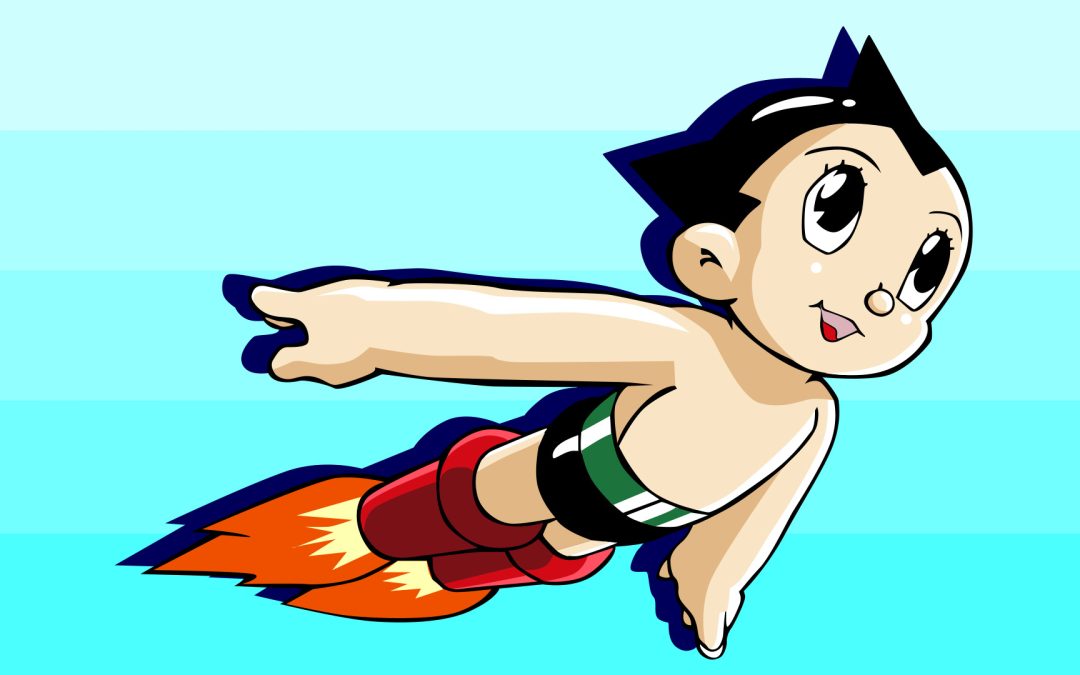
Astro Boy is a conscious robot, nuclear-powered, with synthetic skin giving him the appearance of a twelve-year-old boy and plastic hair that sticks out like horns from the top and the left of his head. He has lasers in his fingertips, rockets in his limbs, blasters in his arms, a super-computer for a brain, “100,000 horsepower” strength, extremely sensitive hearing, spotlights in his eyes, and two 50 caliber machine guns in his buttocks.
Astro Boy was invented by Dr. Tenma to replace his own son, Tobio, who had died in a car accident. Tenma eventually discovered, however, that although designed to look like a boy, Astro could not physically mature. This led Tenma to realize that his robot was really just a robot, and not a boy, and thus could not be his son. Furious (with himself, but projecting it onto Astro), he sold the robot to a sadistic circus ring-leader, and in the process of having to deal with the other robots in the circus, Astro at last began to control his powers while at the same time developing a conscience.
Fortunately for Astro, kindly professor of robotics Dr. Ochanomizu took interest in his plight. After the passage of the Robot law, liberating robots from their condition of slavery and granting them rights of citizenship, Ochanomizu took Astro under his wing to help him develop his conscience and his capacity for learning.
That’s the basic grounding of Astro Boy, as developed by writer/artist Osamu Tezuka. We can see here most of the themes that the further adventures of our hero will address: The difficult relations between humans and robots; the moral corruption and cruelty of which humans are capable; discrimination and the hope for liberation; the notion that consciousness requires both the capacity to learn and conscience; the one to acquire knowledge, the other to develop insight and judgment.
The Astro Boy narrative, as a serial manga, began publication in 1952. [1] The series became a sensation overnight and by the mid-1950s inspired a live-action television show. Then, in 1962, Tezuka developed an animated cartoon series for television – writing, drawing, even animating alongside his staff of six, some of whom went on to become notable figures in the anime industry. Due to budget constraints, the series used what is known as ‘limited animation’: i.e., stock backgrounds, stock shots, limited figure movement, etc. But this actually increases the charm of the series for me; it has a quirky, surrealistically mechanical aura in many of the visuals.
Animation had been an interest for Tezuka long before he initiated this series. His father owned a movie projector, and Tezuka was fascinated with American animated films from quite an early age, primarily those by Walt Disney, although the main influence discernible in the Astro Boy series is that of the Fleischer Brothers. Astro Boy could not duplicate the gloss of better-budgeted American animated television shows, but it did demonstrate a sophisticated humor and a visual inventiveness well in advance of them. (Tezuka’s manga were also in advance of work being done in American comics of the time.) The show was quite successful in Japan and became the first foreign animation series to achieve any popularity in the United States. Tezuka appears to have been rather intellectually restless however, his mind working through an idea until it had played itself out, then moving on to other ideas. So at the end of the TV series, he killed off the character by flying him into the sun (taking a world-destructive bomb with him, thus saving the earth).
Fans were outraged, so Tezuka, still engaged in the manga serializations of the Astro Boy saga, came up with a manga story arc about how Astro was saved by aliens. It’s actually a fascinating story, concerning (along the way) problems with social class, the possibility of intelligence evolving in insects on other planets, time loops, and the Vietnam War, but it goes on for 600 pages and gets quite complicated, so I only mention it here.
The point is that like any good robot, Astro Boy simply could not die. After developing a remake of the original series for television in 1980 (with which he had little to do, beyond supplying stories and designs), Tezuka himself effectively retired the character. But fans would not let him go.
What is it about Astro Boy that appeals to so many people; an audience that includes a wide cross section of the Japanese population, as well as a substantial cult following abroad? By the time Tezuka effectively stopped producing more episodes in the serial, there were readers who had been following Astro Boy for decades, well into their adulthood. Even today, adults speak of their memories of the manga and of the animation series, in glowing terms.
Astro Boy was originally designed for Japanese males in their early teens – hence his physical appearance as a twelve-year old boy. The aesthetic psychology at work here is fairly plain. Astro looked like many of the members of his audience, and despite the absence of any physical blemish, managed to capture the sense of alienation that young people so commonly feel when entering the awkward years of early puberty. He looked human, and yet he was different. He was, after all, a robot.
Nonetheless, there were compensations for this alienation. Astro Boy was extremely smart, had amazing powers, and always demonstrated a greater conscience than many of the adult humans around him. He wasn’t just different, but superior. Fortunately for the world, he had not an ounce of vanity and never exhibited smugness or self-satisfaction of any kind. On the contrary, he was always trying to find his way; trying to be both robot and boy, in a world where many could accept him as neither.
So there’s the initial hook for his young audience, the process of identifying with a familiar though superior hero. But the appeal runs deeper. There are those big, innocent eyes, staring out in wonder at the world of the future. Astro Boy can express a number of emotions, even negative ones, but the two most memorable expressions we see in his face are a fierce determination when in action and a winning, unambiguous smile; unambiguous, because there is not the slightest hint of duplicity or pretense. He is all of a piece – never temperamental or given over to deep doubt; never holding a grudge or engaging in hidden agendas. He says what he means (and frequently takes what humans say all too literally). He is the exemplar of what one might call “sophisticated innocence” – almost a youthful version of Rousseau’s noble savage, capable of theorizing about physics while discussing ethics. “Almost,” because he is still learning. Despite all the action and adventure, learning is Astro Boy’s central preoccupation. Although never appearing pretentiously curious, he questions every new phenomenon that he encounters. And of course he is always willing to help others, frequently at the risk of his own existence. He is a true hero; in many ways an ideal human being. Except, he’s a robot. And that makes all the difference.
There’s a moment in Terminator 2: Judgment Day, when John Connor’s mother looks at him playing with the bodyguard robot and thinks to herself that the robot would make the perfect father. Certainly, part (though not all) of the hope that we have for conscious robots is that through science and technology, human intelligence might produce what apparently God could not – perfection. A conscious robot would be physically stronger than us and thus, in comparison, the “strongest.” It would be more intelligent than us and thus, in comparison, the “most intelligent. To truly replicate human consciousness — and even surpass it — the conscious robot would need a conscience, so in comparison to us, it might be the kindest, wisest, most loyal, and most just.
Alas, we tend to forget that imperfection cannot produce perfection, because perfection is a matter of perspective, and we are always making mistakes. Of course, as we learn more, our views of these mistakes change. They offer opportunities to learn, to reconsider our standards, and to change. Imperfection – in ourselves and in others – is not something we can eliminate but must live with.
Astro Boy actually has four fathers: Dr. Tenma, his inventor who is quite mad and desperate to replace his dead son; Dr. Ochanomizu, the somewhat bumbling, temperamental roboticist who becomes his guardian; “Dad,” the robot Dr. Ochanomizu builds for him – who, it must be said, is little more than a parody of fatherhood; and of course, writer and artist Osama Tezuka, who created him as a character. The flaws of the fictional fathers are underscored. Those of Dr. Ochanomizu are the least noticeable, only because they threaten the least possible harm. Dad’s flaws are treated as comic, but were he a real father, we should be concerned for his children. And Tenma is mentally unstable.
What about Osamu Tezuka? What are his flaws? We get a glimpse of the answer when Tezuka makes an occasional appearance in his manga as narrating character. “‘Once upon a time’ Astro Boy tales, part 1,” is an interesting case in point. [2] Tezuka appears to introduce a prolonged story arc for his character and draws himself with a big nose, oversized glasses, droopy shoulders, fat fingers, and wearing loose clothing and a floppy beret – not the most debonair of appearances. He basically admits that he made a mistake, disappointing audiences by killing off Astro Boy at the end of the television series, while reminding his readers that the show was never intended to be integral with the manga. However, he admits that in response to fan complaints, he carried on the television narrative in a comic strip appearing in newspapers. But now the newspaper series is out of sync with the magazine series! So, he will just have to start the story over again. Tezuka made a virtue of what seemed like flawed story-telling.
This sounds like an outrageous interpolation of the author’s personality into his own fiction. Yet, strangely, it’s in keeping with the principle themes of the Astro Boy narrative.
Astro Boy seems to be an ideal human, but this is merely appearance. Being a robot, he can represent that ideal, but not being human, he can never achieve it. Not programmed to achieve any ideal, he is continually trying to learn how to function as humanly as possible. This is his greatest personality flaw: the failure to accept himself as a robot. Yet it’s also the source of his greatest strength, namely, his ethical commitment.
Let’s put the matter in its own context. In the Japan of the future, as Tezuka imagined it, robots, developed as tools, have achieved something like consciousness. But since they are the result of gradual innovations on previous models, they don’t all share the same level of consciousness. Some are very much like ourselves; some are condemned to following their programming without variation; still others remain remote-controlled machinery. Since the humans of this world were engaged in the innovations responsible for conscious robots, and having grown accustomed to using robots as tools, many of them cannot see the issues arising from sharing the same environment with a separate, intelligent, conscious species. Initially, only a handful of people are sympathetic to the yearning of the conscious robots to be allowed the rights and respect of citizenship.
However, through the intervention of intelligent microbial visitors from another planet, the humans are at last made aware of how much they owe to robots and the respect with which robots ought to be treated. This leads human governments to establish the Robot Law, which has ten Articles, including, notably: Article 1 — Robots were created to make humans happy; and Article 2 — In fulfilling the above, all robots shall have the right to live in freedom and equality. [3]
Notice the tensions inherent to these laws. Article 1 defines robots in terms of the function for which they were invented. As the first article of the Robot Law, it’s designed to limit the possible interpretations: no interpretation can ever be allowed to redefine robots as having a fully independent existence, separate from those who invented them.
The second Article is even more limiting. While it grants robots the right to freedom and equality, it effectively makes this right dependent on the robots ability to realize their existence as defined in the first Article. Where is the “freedom and equality” in this?
Tezuka was apparently aware of this. As more than one story makes clear, the robots’ enjoyment of their “rights” is entirely contingent on their ability to conform to human expectations. This is really not a right but a privilege – a grant from the state that can be revoked without recourse to much by way of legal defense; rather like drivers licenses granted in the United States.
Yet, it’s doubtful that the government could have gone much further without considerable push-back from its human constituency. The wording effectively reassures humans that they retain a political position superior to that of their former robot slaves.
If this sounds familiar, it’s because Tezuka drew the theme of robot-human relations from the history of race relations in America. Since Tezuka learned to draw Africans by copying the style of their representations in American cartoons from the 1930s, there have been complaints that his depiction of them is tainted with racism. These complaints indicate a failure to read the stories themselves or recognize their themes. Tezuka once remarked that he first got the idea for the Astro Boy narrative, while recovering from a beating he received from drunken US soldiers during the Occupation. The experience led him to loathe any form of discrimination. But he was clearly aware of how subtle discrimination could be and of the complexity of the psychology behind it.
So the Robot Law does not entirely produce the stable and happy human-robot society it was intended to. For one thing, prior to this law, humans had simply taken robots for granted. Now, forced to recognize them as separate, individual conscious beings, many people become suspicious of the robots around them. If robots can enjoy their own agency, could they not use that agency to cause humans harm?
These suspicions are complicated by the fact that not all robots share the same degree of consciousness or independent agency. If a robot has been programmed to kill, no matter how conscious it is, and cannot over-ride the program, who’s responsible when it commits murder? And imagine a duplicate Astro Boy that only functions under the remote control of a human. Could such a robot be said to share the freedom and equality of fully conscious robots? Tezuka spent some thirty years exploring possible variants of these and similar dilemmas.
The point is that Astro Boy, as a fully conscious robot with superior abilities and admirable ethics, functions as a focus for some of the most difficult social and ethical problems we face. He is clearly engaged in action-oriented science fiction stories. But he’s also on a pilgrimage through a moral universe. The ambiguity of his existence only underscores the ambiguities of that universe.
Undoubtedly, Tezuka is asking us to empathize with Astro Boy’s human/robot predicament. Equally undoubtedly, our empathy is triggered in some proportion to our ability to perceive Astro as a living entity; specifically as some form of human being, however artificial. It’s not simply that we know, for instance, that he has been invented with artificial tear-ducts and programmed with the ability to weep. We need to perceive this response as being somehow sincere; as an expression of his being Astro Boy and not some fraud perpetuated on us by his inventor. We need to believe that when he weeps, he does so because he feels some sadness or sorrow and not because his inventor wanted to fool us into responding to him “as if.”
In watching or reading Astro Boy, then, what impresses me the most about him — what leads me to empathize with him as a conscious intelligence, as a being approximately (if artificially) human — are his flaws. The single most human gesture that Astro Boy performs, the gesture that truly endeared him to me as a recognizably conscious being, similar to a human, is when his head pops off. Astro Boy’s head is screwed onto his body; otherwise, it is only connected, within, by a coiled cable. Occasionally, Astro Boy experiences a bump or a push so hard, his head pops off, and he has to pause to screw it back on. In moments like this, the flaw in his design becomes obvious, and he has to correct for it; to recognize his own vulnerability, deal with it and move on. It is at these times that he is most like a child who is learning and adapting. His otherness, then, is also what is most human about him.
This theme is built into the narratives. Astro Boy is the super-robot with a superior intellect. But being conscious and capable of emotion, he makes mistakes. He trusts people unwisely; he makes bad decisions; he performs questionable actions exactly because, being innocent in nature, he cannot predict the moral consequences of everything he might do. He can be moody, get angry, and he can weep sincerely, because he feels sorrow. But, he can go through all this, and learn from it and move on, not to a greater state of perfection, but to further adventures, where he will almost certainly make other mistakes. Like us, he bumbles and fumbles his way through life, and yet always carries on.
Notes
[1] My primary source throughout is: The Astro Boy Essays: Osamu Tezuka, Mighty Atom, and the Manga/Anime Revolution; Frederik Schodt; Stone Bridge Press; 2007.
IMDB site, first TV series (1963): http://www.imdb.com/title/tt0056739/?ref_=fn_al_tt_4.
Primary Wikipedia article: http://en.wikipedia.org/wiki/Astro_Boy_%28character%29
[2] Astro Boy, vol. 6; Osamu Tezuka; trans. Frederik J. Schodt; Dark Horse Comics, 2002.
[3] Astro Boy, vol. 8; Osamu Tezuka; trans. Frederik J. Schodt; Dark Horse Comics, 2002.
by E. John Winner | Jul 3, 2026 | Essays on Popular Entertainment and Culture
There have been a number of efforts to produce live action films based on the Batman comics. The first, in the 1940s, developed as a series of interconnected episodes released weekly in theaters. There was a respected, high budget feature length film in the 1980s, directed by Tim Burton, which established the production values expected of cinematic interpretations of Batman that remain to this day. But between the serial of the 1940s and the Tim Burton film, there was a cheaply made, one-off theatrical release developed out of a popular television version of Batman. The film, appearing in 1966 and starring Adam West as the renowned “Caped Crusader,” was titled Batman the Movie (to distinguish it from the tv show) and directed by Leslie H. Martinson. Unlike the other attempts to bring the character to live action cinema, Batman the Movie is a comedy, and since its humor derives from a mainly verbal wit, the film’s real auteur is its screenwriter, Lorenzo Semple, Jr.
Composed with a low-budget television sensibility, Batman the Movie won no Oscars and is destined for nobody’s Hall of Fame. The direction meets minimal standards of acceptable filmmaking, as do most of the film’s other technical endeavors. Aesthetically, however, the minimum is not quite good enough. The movie looks shoddy, not much better than the TV sit-coms of the day. As for the acting, the dialogue is enunciated clearly, but “ham” seems to have been included in every character description. And yet, however unsatisfying as cinema Batman the Movie might be, as a vehicle for signs it is a motherlode of cultural significations.
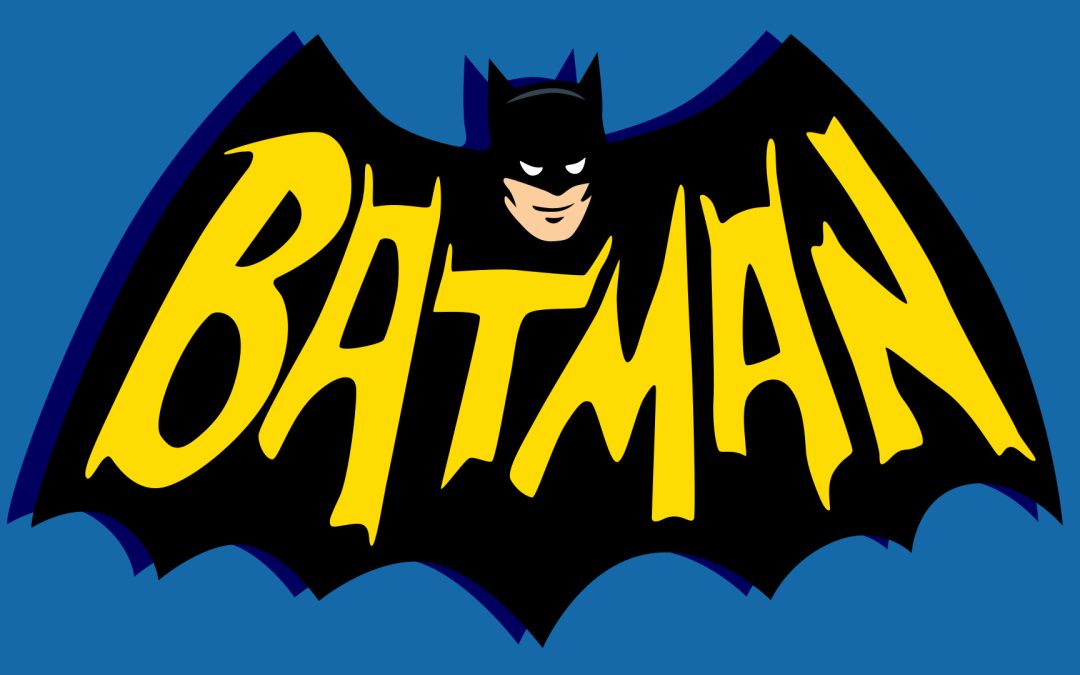
The word ‘Batman’ is presented almost ideogrammatically. The original comic book character has a costume with a yellow oval on the chest, and within the oval is the outline figure of a bat’s head and wings. In the title, the oval is presented, but where the wings should appear, we find the word ‘BATMAN’ presented in letters shaped to conform with the outline of bat wings. Above this word, as in the emblem on the comic book character’s chest, we should expect to find the silhouette of a bat’s head; instead, we find the cartoon head of the comic book character. Alongside this design we find the words ‘the Movie’.
“X: the Movie” is a verbal construction that is somewhat familiar to moviegoers today but was unusual in the 1960s. Indeed, Batman the Movie may be the first film to use such a title. But let’s start with that oval: The word ‘Batman’ we recognize as the name of the character. If he was in the vicinity and we called his name, he would answer. The name as statement signs: ‘Batman is here’. The oval was (according to the fiction) a personal choice of the character, his emblem, his self-presented non-verbal sign of himself. When it is seen on his chest, he no longer needs to be called — he has already answered any possible call — and the emblem presents itself as immediate sign of identification. It says, “Batman is here,” without having to utter it.
In the movie’s opening title, the head appearing above the word ‘Batman’ with letters shaped as wings is a true icon. It is pure duplication of the cartoon Batman and thus represents all that we might expect of his presence, were he here with us. What we have is a graphic presentation of the principle governing much of the presumably humorous significations of the film. Seen through the prism of a perspective especially designed for reading signs, the main title image of the word ‘BATMAN’ presented in Batman’s oval emblem and mounted with the icon of the cartoon character’s head, re-iterates through self-reference the fictionality of the character in a film intentionally reminding us that it is only a fiction.
The principle at work here, serving the rhetorical function of irony, I would like to call “immediate redundancy”: the immediate presentation of a sign appended to another sign, where both signs refer to each other and yet also refer to another object.
Of course, the question is, would the film’s audience translate its title in this fashion? They wouldn’t need to, as their minds would do this rapidly and automatically (although there would need to be some prior training in cultural norms of significance). We are always wearing sign-reading glasses — they’re called “eyes.” What the audience would have been expected to recognize and articulate is the irony in a movie, the title of which asserts the artificiality of its presentation. The fairly hip, culturally informed audience the film was intended for would be expected to recognize the self-referentiality of the title and the artificiality signified and the comic irony implied. They would know that they were not there to indulge the illusion that they were participating in the adventures of the title character; because the title character of the movie is the movie itself, which is wholly consistent with the “Pop-Art” aesthetics that were in vogue in the culture of the time.
___
Smoothness of interaction depends upon the continuous presentation of signs in specific situations, for the appropriateness of the response depends not only on the principal sign but also on the subordinate signs to be observed in that situation. (…) (S)ince remembering (appropriate responses) is unreliable, since it is the consequence of the brain’s capacity to produce random responses if left to itself, learned behavior can be maintained and made reliable only by constant reiteration of instructions for behavior.
To this principle I shall give the name ‘cultural redundancy’.
— Morse Peckham, Explanation and Power†
“Cultural Redundancy” is the theory that stable relations within any cultural group depend largely on the repeated reinforcement of social norms by visual and verbal signs deployable within that cultural group. Peckham discusses this theory in terms of our traffic signs and how we read these in terms of the recurring behavior of other drivers and pedestrians. But it is much easier to see this in a closed cultural example, like the Catholic church (and I mean here the church you may find in your local community). It towers above, covered with medieval iconography, reminding you to be awed by its majesty and history. You walk through the doors – there’s the font, remember to splash yourself with “holy water” — and then into the main hall, filled with people on their knees with bended heads, facing the crucifix hung above the altar. Everything you experience indicates what is expected of you.
All cultural experiences come with similar reinforcement by the signs deployed therein. To be composed of such signs is just the nature of culture itself: their production and deployment; their regularities and irregularities; their continued maintenance; or their transgressions, failures, and displacements.
Batman the Movie is a film about cultural redundancy, and as I’ve noted, its principle comic strategy if that of immediate redundancy, which underscores the film’s thematic interests. The film is about cultural redundancy, because its concern appears to be about why the cultural formations of the United States of the time might manifest a desire for the generation of a fictional character such as Batman.
Batman is something of a cultural parasite. Created by Bob Kane in the late 1930s out of elements borrowed from pulp magazine heroes The Shadow and Doc Savage, he appeared shortly after the appearance of Superman (from the same publisher). Of course he is lacking Superman’s powers, perhaps so as to appeal to those with an inferiority complex: convinced they would never fly, but, gee, wouldn’t it be fun to be a “caped crusader?” In that respect, he actually complements the Superman phenomenon, rather than compete with it for attention. He fits the niche of the “non-super super hero” in the comic universe of the time.
Batman routinely refers to and borrows from popular eccentricities and fads of the day. Science and technology having caught the imagination of the general public by the 1920s, they became the source of innumerable fictional inventions, and Batman has been a part of this trend since his inception: His laboratory produces marvels of science and technology, and he is especially good at creating faster means of transportation and more convenient communications, which were among the aspirations of affluent, post-WWII Americans.
In the 1950s, at a time when EC Comics was the target of Congressional investigations for the portrayals in their magazines of violence and “indecently” dressed female figures, Batman made every effort to avoid physical contact with other human beings (men and women). Violence was reduced to the occasional punch, and Batman could usually fell a foe with a single blow.
Despite its nearly puritanical morality, the comic book was not without a sense of humor. Issues subtly spoofed popular singers, fashion design, and Madison Avenue sales campaigns. In one story, Batman’s archenemy, the Joker, has become a legitimate businessman. Unfortunately, his enterprise fails, and he has to resort to robbing banks to pay off the investors. What was never spoofed, however, were churches, unelected governmental officials, medical doctors, and any married women over the age of thirty (Mom, her apple pie, and all that). In short, any person, position, or institution Americans thought to be unquestionably trustworthy was treated with the utmost respect.
This leaves Batman open to the criticism that he feeds off his culture and repays it by re-enforcing the status quo. Of course, such criticism can be made of many fictional heroes, all of whom are generated from our fondest hopes or our least frightening fears (darker fears tending to breed monsters). But, Batman was certainly among the most ripe for this sort of critique in the 1960s, when such critiques became popular. A critical satire like Batman the Movie was inevitable and appeared in other media, including more than one spoof in Mad Magazine. Not because Batman had changed any or had lost touch with the culture that had given him birth. Rather, the culture itself was changing, effectively losing touch with the cultural norms that Batman had been quite literally sworn to uphold.
There are a number of phenomena occurring in the 1960s that we could discuss as revealing the schizophrenic nature of American culture at the time. Most obvious would be America’s military engagement in Vietnam – the colonial engagement that could not, in principle, secure a colony; the proxy war with communism that could only gain support from unquestioning, self-proclaimed “patriots”; the political embarrassment of both major parties that would lead to one president deciding not to run for re-election; and the election of another president who would be forced into resignation for corruption.
However, perhaps wisely, writer Lorenzo Semple keeps his Batman critique largely apolitical. Exercising our intellects in the presence of such a two-dimensional character as Batman would insult him, and Semple’s asking less of an audience in raising matters of real importance would insult us. Nonetheless, it is rather odd to find a film made in the 1960s, in which the hottest political issue seems to be whether there should be a United Nations or a “United World Organization” as it is represented euphemistically in the film. But since the film largely sets politics aside, so shall we.
___
The movie’s humor hinges on the principle of immediate redundancy: a sign is introduced to refer to an object, but a second sign is presented with it. The second sign points directly to the first sign, but also to the first sign’s object. The second sign is presented so as to assure that the first sign will not be misread by any reasonable interpreter with the necessary contextual knowledge. However, anyone having a reasonably good education should find this reinforcement very obvious (indeed, perhaps a little denigrating of one’s education). Therein lies the humor of it: immediate redundancy is not only over-coding, it is overkill.
Think of a common traffic sign in the United States, the “Stop” sign. Its shape and color form an ideogram of the legal requirement to “stop” by it. But it contains an immediate redundancy: the word “STOP” printed on it. We hardly notice this, because we recognize that the image of the stop sign is intended to be recognizable to those not literate enough to read the word ‘STOP’. But suppose stop signs were posted beneath another sign, reading: “The sign beneath this is a stop sign. You are legally required to stop here.” And on this sign, the picture of a car screeching to a halt. And beneath the stop sign, another sign, “The signs above mean that you are to stop here!” with the image of a policeman handing out a ticket to a car’s driver. Now this is all getting very silly. But this is the nature of immediate redundancy: it multiplies signs without increasing significance, which then raises the question as to the value of the original sign. One benefit of the immediate redundancy of the common stop sign is that it reminds us that traffic laws are social conventions and not divine commands. This knowledge tempts many to ignore stop signs, sometimes at most inopportune moments. But it also reassures us that we humans are in command of the laws we enact and agree to observe.
Batman the Movie is filled with signs pointing at signs pointing at signs. Even Batman’s costume is immediately redundant. The mask is shaped like a bat’s head, the cape shaped like bat wings. Do we really need the silhouette of a bat in the yellow oval on his chest to remind us what the costume signifies?
Although it is frequently in the background of the film, one humorously repeated technique governed by the principle of immediate redundancy surfaces early in a manner we could expect from a film so self-consciously artificial. Our attention is forced to it by a camera shot that has no other purpose. Arriving at the scene of an attempted hijacking of a yacht (which turns out to be an optical illusion), Batman lowers a ladder from the Batcopter, in order to climb down to the endangered yacht. The editing cuts to a shot of the bottom of the ladder, to which we find appended a black sign with white letters reading: “BATLADDER.” Well, of course. What else would it be?
As we might expect, immediate redundancy is used in Batman the Movie verbally as well as visually. At a press conference, Batman tries to explain why he did not stop the yacht from being hijacked; or rather to explain how the yacht was actually an optical illusion; or rather to evade questions concerning the yacht, fearing that answers would cause a public panic. As the press conference ends, a woman claiming to be a reporter from the Soviet Union asks an interesting question. But first, it should be noted that this woman is actually the Catwoman, one of Batman’s fiercest enemies. She’s wearing a disguise, in that she doesn’t have her mask on. We learn later that this indeed is the correct interpretation when, shortly after the press conference, one of her henchmen calls her “Catwoman” in a restaurant while her mask is still off, and she chides him for referring to her “true identity” in public. However, loyal fans of the television show would recognize her as the Catwoman without her mask, because, in keeping with the principle of immediate redundancy, she is wearing apparel made from cheetah furs; that is, from the skin of a cat.
But let’s return to the press conference. The question Catwoman asks of the Batman is simply a request: would he please take off his mask so she could take a photograph of him?
Of course, we know that Batman’s mask is his chief deception. Reviewers and critics find such moments of deception fascinating, psychologically, but we won’t go down that trail. What interests us here is the way Batman successfully explains his refusing the request. To be plain, Catwoman’s request amounts to this: “Would you please reveal your secret identity?” That’s implicit. But Batman makes it explicit. He refuses to reveal his secret identity, because to do so would reveal his secret identity.
Both Batman and the dumbfounded audience are relieved of the embarrassment of this tautological faux pas by Batman’s friend, Police Commissioner Gordon, who argues that such a revelation would ruin Batman’s ability to act as a crime fighter, which on reflection actually makes no sense at all. (Why don’t all police officers wear masks? It isn’t like Batman is operating undercover.) But the damage is done. There isn’t any reason for not revealing his “secret identity,” because in a sense he doesn’t have one. He is always Batman. Bruce Wayne is a convenient fiction. Yet in the context of this blatantly fictional film, this “always Batman” is also a fiction.
As Morse Peckham argues in Explanation and Power, the principle of cultural redundancy is enforced in order to maintain ideological coherence in a conventional system of signs.† Signs are encountered so frequently that their references are assumed true; vouchsafed by familiarity. One sees the psychological advantage in such assumptions. A world of signs held constantly under suspicion, interpretation always delayed by doubt, would prove intolerable. Whatever the significant status of a stop sign, stopping for it is preferable to anxiously wondering if there’s some hidden agenda implicit in its presentation.
But there’s a cost. Immediate redundancy ironically destabilizes the very assurance the redundancy per se seems to offer us. If signs reinforce themselves too frequently, they risk discovery as essentially contentless conventions or as having a referent much less important than the signs seemed to promise. The Batman of Batman the Movie is not a master crime fighter. He is a clown.
To discover the bad faith of a sign is to discover the possibly adversarial and possibly duplicitous agenda of those attempting to signify with it. The cultural redundancy can no longer reassure us and thus loses its power to stabilize cultural responses. We no longer trust those deploying the signs, and we no longer trust the signs themselves. And while one certainly learns to live with such a situation, a condition of total trust can never be re-established.
†Peckham, M.; Explanation and Power: The Control of Human Behavior; 1979, University of Minnesota Press.
